 Bug FAQ
Broad-necked Root Borer
Prionus laticollis · Order: Coleoptera · Family: Cerambycidae
Also called: Broadnecked Root Borer, Broad Necked Prionus
Source: Wikipedia
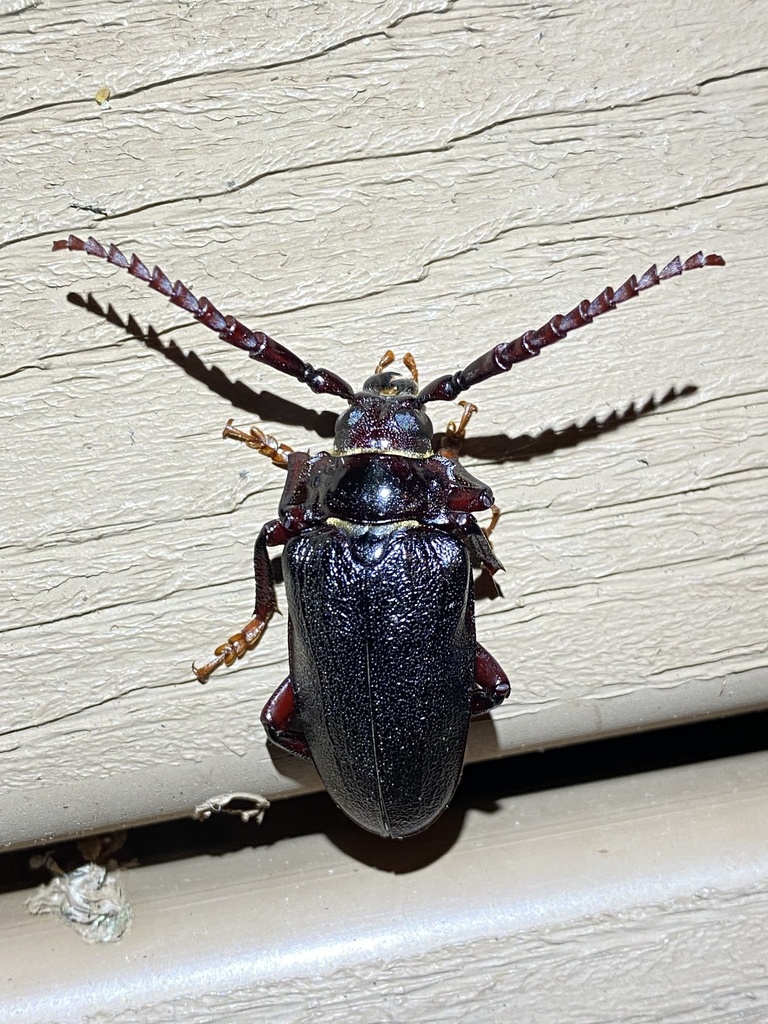
Broad-necked Root Borer adults are 2 to 5 cm long, with females larger than males. They are active at dusk and night, living near the bases of oak trees and other hosts. Larvae tunnel underground for about three years, feeding on living roots and pupating in spring about 10 cm deep.
Source: Wikipedia
How to recognize it
The beetle has a rough-punctured elytral surface and antennae with twelve segments.
Source: Wikipedia
Size
Adults measure roughly 2 to 5 cm, females being noticeably larger than males.
Source: Wikipedia
Where it lives
They are most active at dusk and during the night.
Source: Wikipedia
What it eats
Larvae feed on the living roots of many trees and shrubs, damaging the plants. They tunnel downward through soil to reach and eat these roots.
Source: Wikipedia
Life cycle
The species likely needs about three years to complete its life cycle. Pupation occurs in spring, roughly 10 cm below the ground surface.
Source: Wikipedia
When you see it
Adults are active at dusk and at night. Pupation takes place in the spring.
Source: Wikipedia
Where it comes from
Their range covers eastern North America from Quebec down to Arkansas.
Source: Wikipedia
Lookalikes
Other Prionus species with twelve antennal segments have smooth punctate elytra (e.g., P. pocularis) or more than twelve segments (e.g., P. imbricornis).
Source: Wikipedia
Where it is found in the US
Recorded in 27 of 51 states and DC. Most records: Massachusetts, New York, Pennsylvania, Connecticut, New Jersey, Maryland, Virginia, North Carolina.
Darker = more records. Counts are museum and citizen-science records, not population size.
Source: GBIF
Status: native in North America; native in Canada. Source: iNaturalist
Months it is reported in the US
Source: GBIF
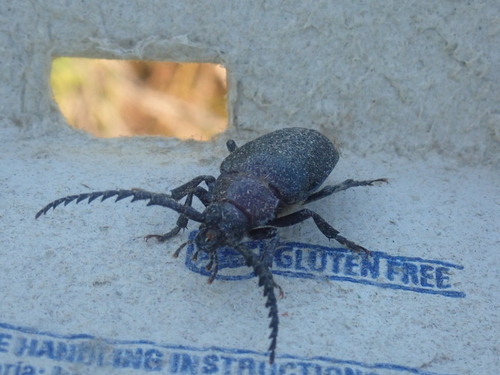
More photos
Questions people ask
Do Broad-necked Root Borers damage trees?
Yes, the larvae feed on and tunnel through the roots of many trees and shrubs, harming them.
Source: Wikipedia
How long does it take for this beetle to develop?
The life cycle probably lasts about three years, with pupation in spring about 10 cm underground.
Source: Wikipedia
Same family (Cerambycidae)
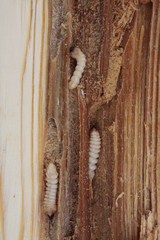 House LonghornHylotrupes bajulusCan damage your home
 Asian Longhorned BeetleAnoplophora glabripennisDamages trees, gardens or crops
 Red Milkweed BeetleTetraopes tetrophthalmus
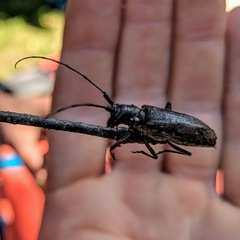 White-spotted SawyerMonochamus scutellatusCan damage your home
 Red Pine Longhorn BeetleStictoleptura rubra
 Spotted Longhorn BeetleRutpela maculataDamages trees, gardens or crops
Sources
- Wikipedia: https://en.wikipedia.org/wiki/Prionus_laticollis
Look it up elsewhere: GBIF · iNaturalist · BugGuide · ITIS · Wikipedia
Text written 2026-10-22 from the sources above and checked sentence by sentence against them. Data fetched 2026-10-22.