 Bug FAQ
Brachyta interrogationis
Brachyta interrogationis · Order: Coleoptera · Family: Cerambycidae


Brachyta interrogationis is a black beetle that varies widely in its wing-cover patterns, with over 150 described forms. It lives in boreal-mountainous areas of Europe and Asia, up to 2700 m in the Alps, and the adults visit flowers from May to August.
Source: Wikipedia
How to recognize it
The beetle has a black body and highly variable elytra, with more than 150 described varieties.
Source: Wikipedia
Size
Adults measure about 9 to 19 mm in length.
Source: Wikipedia
Where it lives
In Europe it is found in boreal-mountainous regions, reaching the Italian and French Alps in the south and the Arctic Circle in the north. In the Alps it can be encountered up to 2700 m above sea level.
Source: Wikipedia
What it eats
Larvae develop in soil, feeding on the roots of grasses and other perennial plants.
Source: Wikipedia
Life cycle
Development from larva to adult takes one to two years, after which a pupation chamber is formed and the adult emerges in May or June.
Source: Wikipedia
When you see it
Adults are active on flowers from about May through August.
Source: Wikipedia
More photos


Same family (Cerambycidae)
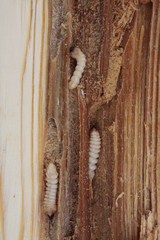 House LonghornHylotrupes bajulusCan damage your home
 Asian Longhorned BeetleAnoplophora glabripennisDamages trees, gardens or crops
 Red Milkweed BeetleTetraopes tetrophthalmus
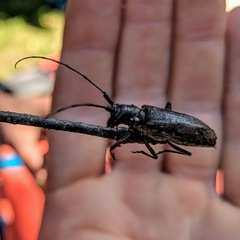 White-spotted SawyerMonochamus scutellatusCan damage your home
 Red Pine Longhorn BeetleStictoleptura rubra
 Spotted Longhorn BeetleRutpela maculataDamages trees, gardens or crops
Sources
- Wikipedia: https://en.wikipedia.org/wiki/Brachyta_interrogationis
Look it up elsewhere: GBIF · iNaturalist · BugGuide · Wikipedia
Text written 2026-10-23 from the sources above and checked sentence by sentence against them. Data fetched 2026-10-22.