 Bug FAQ
Brachygastra lecheguana
Brachygastra lecheguana · Order: Hymenoptera · Family: Vespidae
Source: Wikipedia
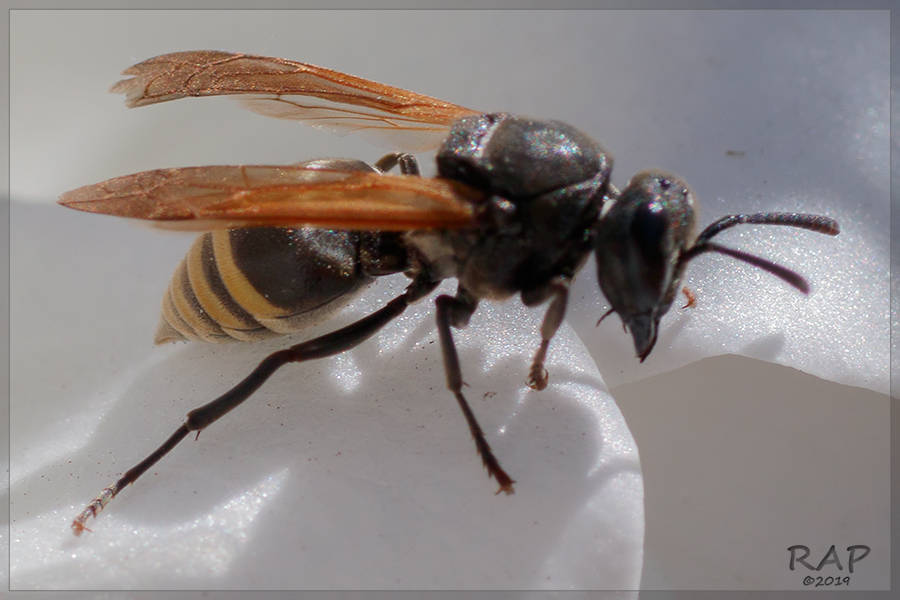
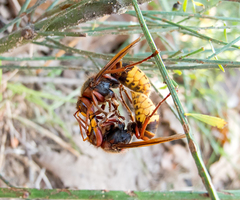
Queens and workers are about 7.5 to 9 mm long, while males are slightly smaller. They are black with yellow stripes on the abdomen and yellow patches on the head and thorax. The wasps build perennial nests in grassland underbrush, preferring temperate, open areas.
Source: Wikipedia
How to recognize it
The insect is black with yellow abdominal stripes and yellow patches on the head and thorax.
Source: Wikipedia
Size
Queens and workers measure roughly 7.5 to 9 mm, and males are about 7.5 to 8 mm long.
Source: Wikipedia
Is it a pest in the house?
It nests in grassland underbrush and is employed as a biological control agent in coffee farms.
Source: Wikipedia
Does it bite or sting?
Its sting is moderately painful and uses a barbed stinger that can be left in the victim after envenomation.
Source: Wikipedia
How to get rid of it
It is used to control leaf-miner pests in coffee plantations, and studies have examined pesticide effects on its health.
Source: Wikipedia
Where it lives
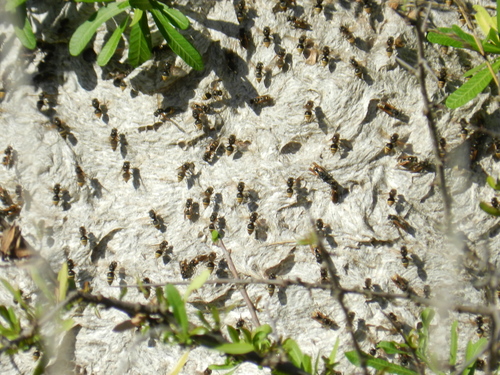
It nests in underbrush within grassland environments, favoring temperate, open, less humid areas.
Source: Wikipedia
What it eats
Members of its genus store honey, and it is used as a biological control in coffee plantations against leaf-miner pests.
Source: Wikipedia
Life cycle
It is a swarm-founding wasp, with new colonies started in spring by several fertile queens and a few workers. Nests are perennial and can persist for several years.
Source: Wikipedia
When you see it
New colonies are established in the spring when swarms of queens and workers locate fresh nest sites.
Source: Wikipedia
Where it comes from
Its range extends from Mexico through South America down to Argentina.
Source: Wikipedia
Lookalikes
It closely resembles several vespid and potter wasps, as well as some crabronid species, due to similar coloration and shape.
Source: Wikipedia
Where it is found in the US
Recorded in 1 of 51 states and DC. Most records: Texas.
Darker = more records. Counts are museum and citizen-science records, not population size.
Source: GBIF
More photos

Questions people ask
How big are Brachygastra lecheguana wasps?
Queens and workers are about 7.5 to 9 mm long, while males are slightly smaller at 7.5 to 8 mm.
Source: Wikipedia
Where do they build their nests?
They build nests in the underbrush of grassland areas, preferring open, temperate environments.
Source: Wikipedia
Are they dangerous to humans?
They can sting, and the sting is described as moderately painful.
Source: Wikipedia
Do they help control garden pests?
Yes, they are used as biological control agents in coffee plantations to suppress leaf-miner insects.
Source: Wikipedia
Same family (Vespidae)


Sources
- Wikipedia: https://en.wikipedia.org/wiki/Brachygastra_lecheguana
Look it up elsewhere: GBIF · iNaturalist · BugGuide · Wikipedia
Text written 2026-10-23 from the sources above and checked sentence by sentence against them. Data fetched 2026-10-22.