 Bug FAQ
Black-tailed Hornet
Vespa ducalis · Order: Hymenoptera · Family: Vespidae

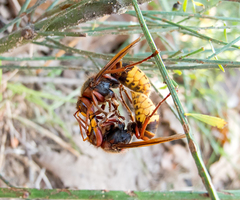
Workers are 24 to 32 mm long and the queen about 37 mm; they are only a little smaller than the Asian giant hornet. They have a distinctive black tail and build small underground nests of about 50 individuals. The larvae feed on paper-wasp pupae and larvae, and adults raid paper-wasp nests for those brood stages.
Source: Wikipedia
How to recognize it
They are recognized by a black tail.
Source: Wikipedia
Size
Workers measure 24 to 32 mm in length, while the queen is about 37 mm long.
Source: Wikipedia
Where it lives
Nests are built underground and usually hold around 50 hornets.
Source: Wikipedia
What it eats
Adult hornets often attack paper-wasp nests to harvest those brood stages, usually ignoring the adult wasps.
Source: Wikipedia
Life cycle
Colonies are the smallest among Vespa species. Nests are built underground and typically contain about 50 individuals.
Source: Wikipedia
Where it comes from
It occurs across Asia, including China, Hong Kong, northeast India, Japan, the Korean Peninsula, Myanmar, Nepal, Siberia, Taiwan, Thailand and central Vietnam.
Source: Wikipedia
More photos


Questions people ask
What do Black-tailed Hornets eat?
Their larvae eat paper-wasp pupae and larvae, and the adults raid paper-wasp nests for those brood stages.
Source: Wikipedia
Where are they found?
They live in many Asian countries, such as China, Japan, Korea, India, Myanmar, Nepal, Siberia, Taiwan, Thailand and Vietnam.
Source: Wikipedia
Same family (Vespidae)


Sources
- Wikipedia: https://en.wikipedia.org/wiki/Vespa_ducalis
Look it up elsewhere: GBIF · iNaturalist · BugGuide · Wikipedia
Text written 2026-10-23 from the sources above and checked sentence by sentence against them. Data fetched 2026-10-22.