 Bug FAQ
Black Shield Hornet
Vespa bicolor · Order: Hymenoptera · Family: Vespidae
Also called: Black Shield Wasp

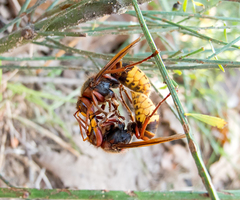
The black shield hornet, Vespa bicolor, is a wasp with a dark, shield-like appearance. It lives on Hainan Island in China and can be seen in many settings, including near homes. It hunts honey bees to feed its larvae.
Source: Wikipedia
How to recognize it
Vespa bicolor is known as the black shield wasp because of its dark, shield-shaped body.
Source: Wikipedia
Is it a pest in the house?
The species can be encountered near houses and other human structures.
Source: Wikipedia
Where it lives
It occupies a wide range of environments and is often found close to human dwellings.
Source: Wikipedia
What it eats
Adults capture honey bees and bring them back to the nest to feed their larvae.
Source: Wikipedia
Where it comes from
Its native range is limited to the Chinese island of Hainan.
Source: Wikipedia
Lookalikes
It may be confused with members of the genus Parapolybia.
Source: Wikipedia
More photos


Questions people ask
Where is the black shield hornet found?
It is native to Hainan Island in China and can appear in many habitats, often close to homes.
Source: Wikipedia
Same family (Vespidae)


Sources
- Wikipedia: https://en.wikipedia.org/wiki/Vespa_bicolor
Look it up elsewhere: GBIF · iNaturalist · BugGuide · Wikipedia
Text written 2026-10-23 from the sources above and checked sentence by sentence against them. Data fetched 2026-10-22.