 Bug FAQ
Black Pine Sawyer Beetle
Monochamus galloprovincialis · Order: Coleoptera · Family: Cerambycidae
Also called: Pine Sawyer
Source: Wikipedia

The black pine sawyer beetle (Monochamus galloprovincialis) is found across Europe, the Caucasus, and the Canary Islands. It carries the pine-wilting nematode Bursaphelenchus xylophilus and can host the parasitoid wasp Dolichomitus tuberculatus.
Source: Wikipedia
How to recognize it
Monochamus galloprovincialis is also called the black pine sawyer beetle.
Source: Wikipedia
Where it lives
It naturally occurs throughout Europe and the Caucasus. It has been introduced to the Canary Islands.
Source: Wikipedia
What it eats
It acts as a vector for the parasitic nematode Bursaphelenchus xylophilus. It also serves as a host for the parasitoid wasp Dolichomitus tuberculatus.
Source: Wikipedia
Life cycle
The species was first described by Olivier in 1795 under the genus Cerambyx.
Source: Wikipedia
Where it comes from
Its native range includes Europe and the Caucasus.
Source: Wikipedia
More photos


Questions people ask
Where is the black pine sawyer beetle found?
It lives naturally across Europe and the Caucasus and has been introduced to the Canary Islands.
Source: Wikipedia
What damage does this beetle cause?
It spreads the pine-wilting nematode Bursaphelenchus xylophilus, which can kill pine trees.
Source: Wikipedia
What other organisms are associated with this beetle?
It can host the parasitoid wasp Dolichomitus tuberculatus.
Source: Wikipedia
When was this species first described?
It was described by Olivier in 1795 under the name Cerambyx.
Source: Wikipedia
Same family (Cerambycidae)
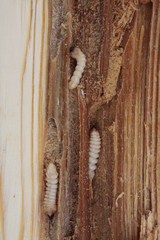 House LonghornHylotrupes bajulusCan damage your home
 Asian Longhorned BeetleAnoplophora glabripennisDamages trees, gardens or crops
 Red Milkweed BeetleTetraopes tetrophthalmus
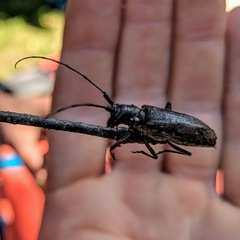 White-spotted SawyerMonochamus scutellatusCan damage your home
 Red Pine Longhorn BeetleStictoleptura rubra
 Spotted Longhorn BeetleRutpela maculataDamages trees, gardens or crops
Sources
- Wikipedia: https://en.wikipedia.org/wiki/Monochamus_galloprovincialis
Look it up elsewhere: GBIF · iNaturalist · BugGuide · Wikipedia
Text written 2026-10-22 from the sources above and checked sentence by sentence against them. Data fetched 2026-10-22.