 Bug FAQ
Black Fire Beetle
Melanophila acuminata · Order: Coleoptera · Family: Buprestidae
Source: Wikipedia

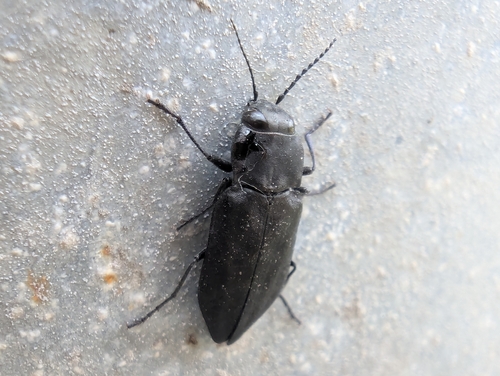
The black fire beetle is a metallic-black beetle about 7 to 11 mm long with pointed elytra and prominent eyes. Adults swarm freshly burned conifer trees, especially pine and fir, and can gather in huge numbers on hot, charred wood. It occurs in North America (including the United States) and many other regions worldwide, and it feeds on sap, fluids from burned trees and decaying organic matter.
Source: Wikipedia
How to recognize it
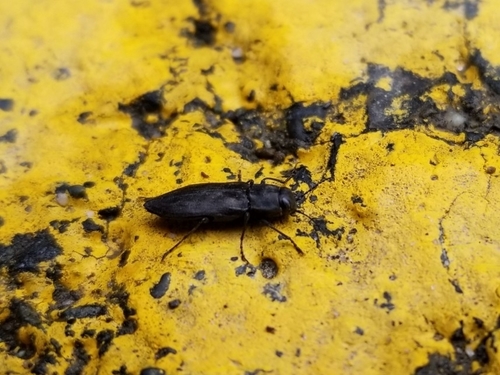
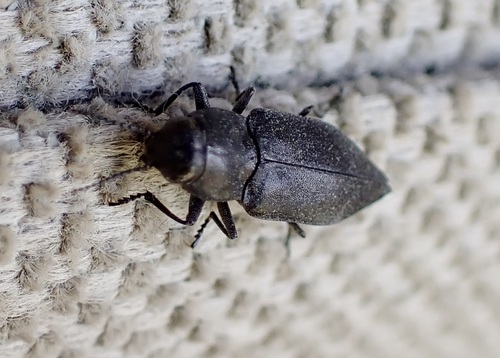
It has a metallic-black body with elytra that end in a pointed tip and a head with prominent eyes and transverse lines.
Source: Wikipedia
Size
Adults measure 7 to 11 mm in length, with the dorsal surface 8 to 11 mm long.
Source: Wikipedia
Is it a pest in the house?
The species can cause large-scale infestations of human infrastructure because it is drawn to heat sources.
Source: Wikipedia
How to get rid of it
- Conservation actions include prescribed burns and controlled forest management to maintain its habitat.
- Public awareness campaigns educate stakeholders about the beetle’s conservation needs.
Source: Wikipedia
Where it lives
The beetle is attracted to freshly burned conifer trees, using thoracic sensors to locate the heat. In the Nearctic region it swarms in huge numbers on pine, fir and other conifers after forest fires.
Source: Wikipedia
What it eats
It feeds on the sap and other fluids of burned trees and on various plant hosts. It also consumes decaying organic material such as fungi, microorganisms and animal flesh found on fire-affected sites.
Source: Wikipedia
Life cycle
Parents guard and groom egg clusters to improve hatchling survival.
Source: Wikipedia
When you see it
Adults appear in large swarms during forest fire events and form groups on charred vegetation.
Source: Wikipedia
Where it comes from
It is native to North America (including the United States) as well as the Caribbean, Europe, northern Asia, Central and southern America, and parts of Australia and New Guinea.
Source: Wikipedia
Where it is found in the US
Recorded in 19 of 51 states and DC. Most records: Idaho, Alaska, California, Michigan, Washington, Minnesota, Montana, Colorado.
Darker = more records. Counts are museum and citizen-science records, not population size.
Source: GBIF
Status: native in North America; native in Canada. Source: iNaturalist
Months it is reported in the US
Source: GBIF
More photos
Questions people ask
How can I prevent large infestations of black fire beetles?
Reduce heat sources near structures and manage fire-affected areas with controlled burns and proper forest management.
Source: Wikipedia
Same family (Buprestidae)
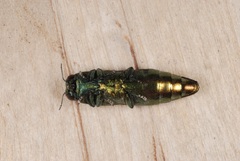 Emerald Ash BorerAgrilus planipennisDamages trees, gardens or crops
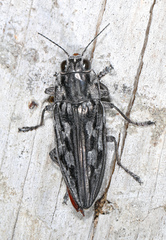 Sculptured Pine BorerChalcophora virginiensisDamages trees, gardens or crops
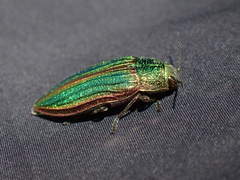 Golden Buprestid BeetleBuprestis aurulenta
 Anthaxia nitidulaDamages trees, gardens or crops
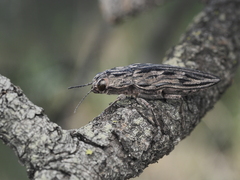 Western Sculptured Pine BorerChalcophora angulicollis
 Anthaxia quadripunctata
Sources
- Wikipedia: https://en.wikipedia.org/wiki/Melanophila_acuminata
Look it up elsewhere: GBIF · iNaturalist · BugGuide · ITIS · Wikipedia
Text written 2026-10-26 from the sources above and checked sentence by sentence against them. Data fetched 2026-10-26.