 Bug FAQ
Bishop's Mitre Shield Bug
Aelia acuminata · Order: Hemiptera · Family: Pentatomidae
Also called: Bishop's Mitre
Source: Wikipedia
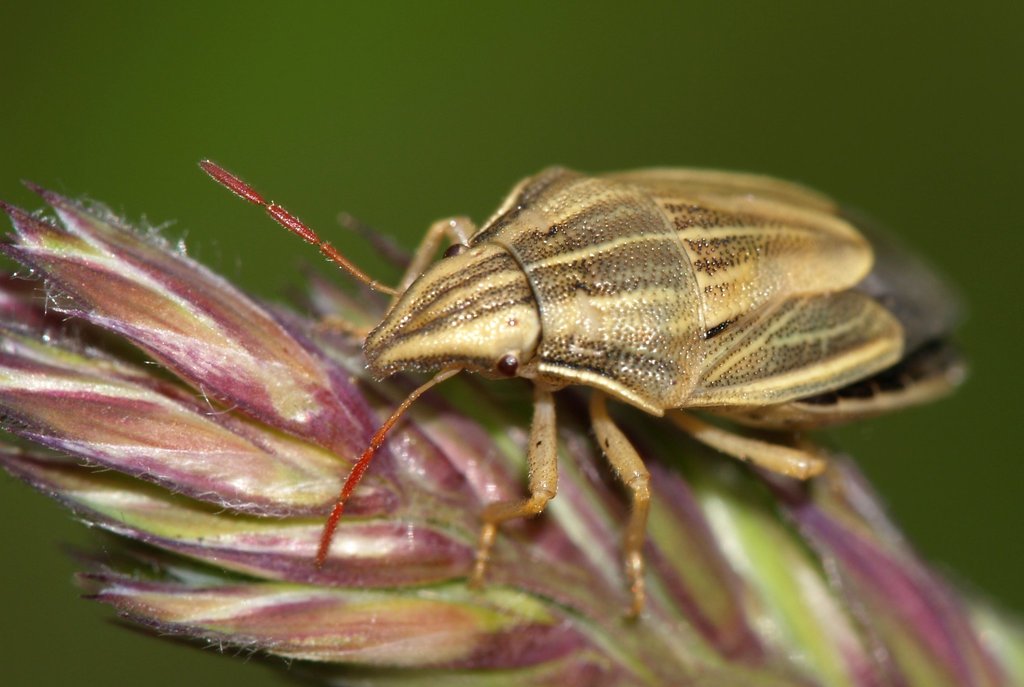
The Bishop's Mitre Shield Bug is a small, light-brown insect that lives in dry meadows and cereal fields across Europe, North Africa and northern Asia. It eats a variety of grasses such as fescue, bluegrass, bent, orchard, rye and bromus, and it has one generation per year with five nymph stages.
Source: Wikipedia
How to recognize it
Its body is slightly elongated with a pointed head and a light brown colour marked by darker brown lines along the length.
Source: Wikipedia
Size
Adults are about 5 to 9 mm long (0.2 to 0.35 in).
Source: Wikipedia
Where it lives
It lives mainly in dry meadows and cereal fields, up to about 1300 m in the Alps.
Source: Wikipedia
What it eats
It is herbivorous, feeding on many wild grasses and cultivated cereals.
Source: Wikipedia
Life cycle
It has one generation per year (univoltine). Development passes through five nymphal stages.
Source: Wikipedia
More photos


Questions people ask
Does this bug bite people or pets?
No, it feeds only on plant sap from grasses and cereals.
Source: Wikipedia
Is it a problem for my garden or crops?
Yes, because it feeds on a range of grasses and cereal crops, it can cause damage to those plants.
Source: Wikipedia
Same family (Pentatomidae)
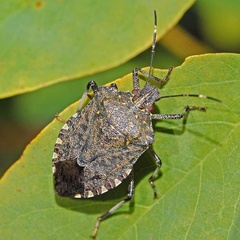 Brown Marmorated Stink BugHalyomorpha halysDamages trees, gardens or crops
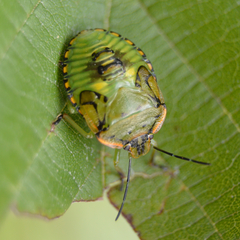 Green Stink BugChinavia hilarisDamages trees, gardens or crops
 Harlequin BugMurgantia histrionicaDamages trees, gardens or crops
 Brown Stink BugEuschistus servusDamages trees, gardens or crops
 Green Shield BugPalomena prasina
 European Striped Shield BugGraphosoma italicum
Sources
- Wikipedia: https://en.wikipedia.org/wiki/Aelia_acuminata
Look it up elsewhere: GBIF · iNaturalist · BugGuide · ITIS · Wikipedia
Text written 2026-10-22 from the sources above and checked sentence by sentence against them. Data fetched 2026-10-22.