 Bug FAQ
Bifurcate Trashline Orbweaver
Allocyclosa bifurca · Order: Araneae · Family: Araneidae
Also called: orb weavers

Females are 5 to 9 mm long and have a distinctive forked abdomen with two M-shaped humps; males are much smaller at 2 to 3 mm.
Source: Wikipedia
How to recognize it
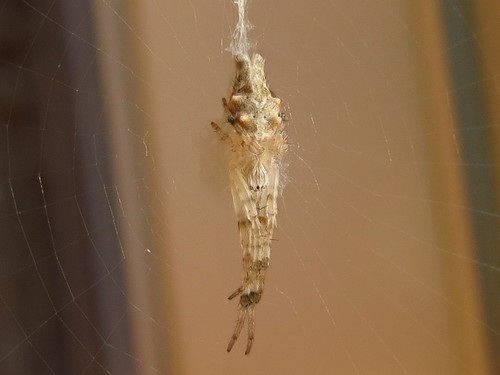
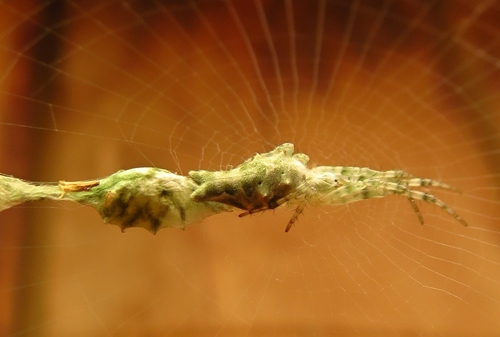
Both sexes have a forked abdomen tip with two humps shaped like the letter M. The spiders are grey-green; females show a red patch on the underside between the epigynum and spinnerets.
Source: Wikipedia
Size
Females range from five to nine millimetres, while males are only two to three millimetres long.
Source: Wikipedia
Where it lives
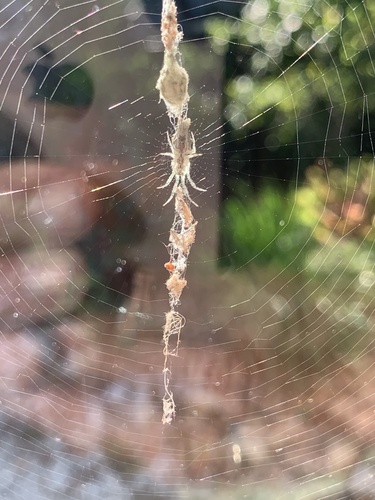
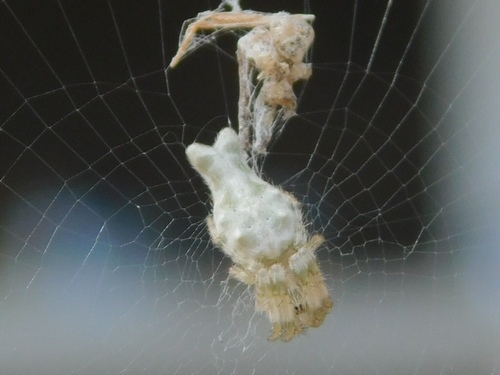
They build orb webs six to eight inches across and use a form of protective mimicry. Females often sit in the centre of a vertical row of web decorations that includes egg sacs and wrapped prey.
Source: Wikipedia
Life cycle
Males are very uncommon, likely because their small size makes them easy to overlook. Females may be able to reproduce without males, suggesting possible parthenogenesis.
Source: Wikipedia
Lookalikes
Originally described as Cyrtophora bifurca in 1887, it was moved to its own genus in 1999.
Source: Wikipedia
Where it is found in the US
Recorded in 3 of 51 states and DC. Most records: Texas, Florida, Louisiana.
Darker = more records. Counts are museum and citizen-science records, not population size.
Source: GBIF
Status: native in North America. Source: iNaturalist
Months it is reported in the US
Source: GBIF
More photos
Questions people ask
How can I tell this spider apart from similar species?
Look for the forked abdomen tip with two M-shaped humps; females also have a red patch on the underside, features not found in typical Cyrtophora spiders.
Source: Wikipedia
Same family (Araneidae)


Sources
- Wikipedia: https://en.wikipedia.org/wiki/Allocyclosa
Look it up elsewhere: GBIF · iNaturalist · BugGuide · ITIS · Wikipedia
Text written 2026-10-24 from the sources above and checked sentence by sentence against them. Data fetched 2026-10-24.