 Bug FAQ
Belonocnema treatae
Belonocnema treatae · Order: Hymenoptera · Family: Cynipidae
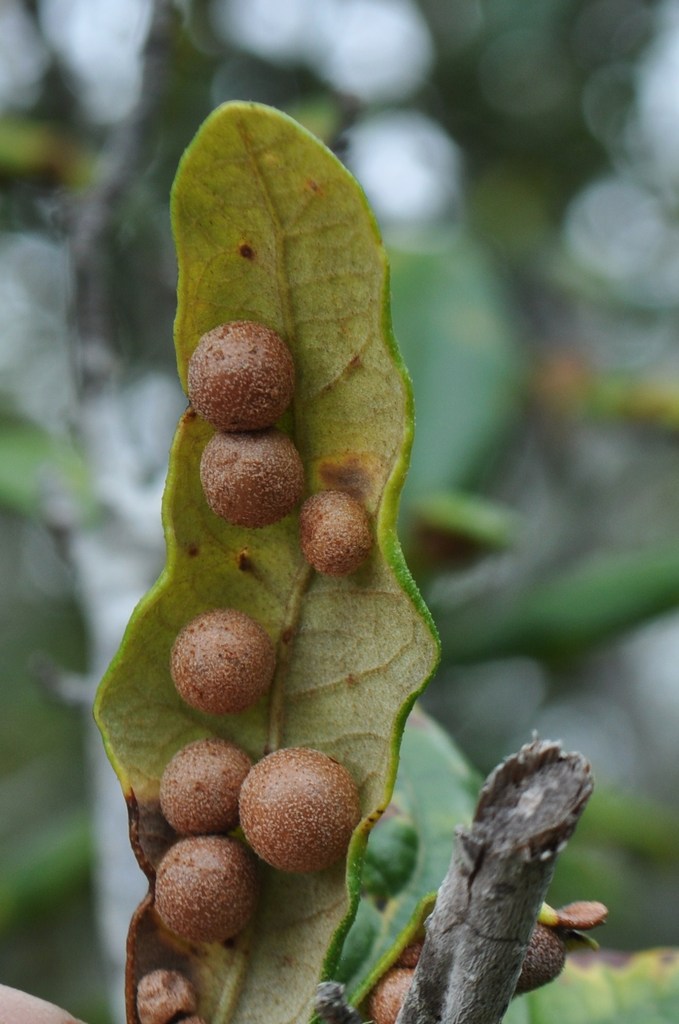
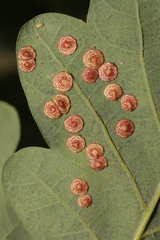
Belonocnema treatae is a gall-wasp that makes smooth, single-chambered ball galls on the underside of oak leaves, which start orange or light brown and darken with age.
Source: Wikipedia
How to recognize it
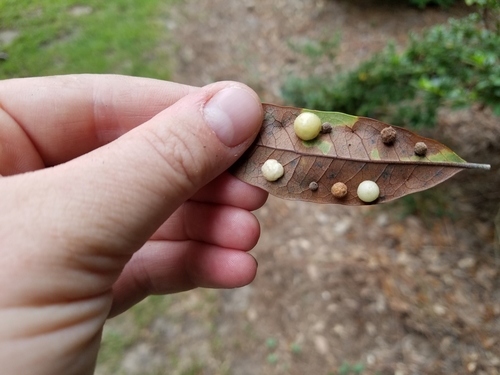
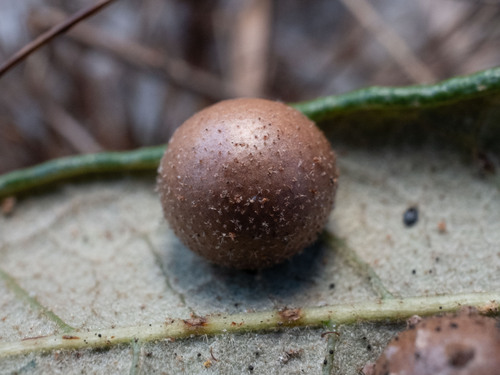
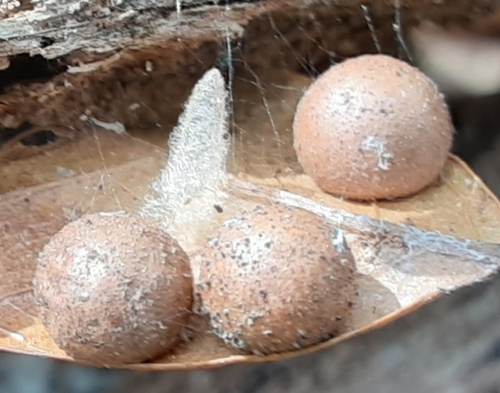
The asexual generation makes smooth, single-chambered ball galls on the underside of leaves. Young galls start orange or light brown and turn darker as they age.
Source: Wikipedia
Size
The fore tibia’s front spur is shorter than the basitarsus, and both generations have tibial spurs.
Source: Wikipedia
What it eats
It induces galls on live oak (Quercus virginiana) and occasionally on sand live oak (Quercus geminata).
Source: Wikipedia
Life cycle
The species has alternating sexual and asexual generations.
Source: Wikipedia
When you see it
Sexual adults appear from mid-March to the end of April, matching the leaf flush of Q. virginiana.
Source: Wikipedia
Lookalikes
It can be told apart from B. fossoria because the front spur on the fore tibia is shorter than the basitarsus and both generations have tibial spurs. In the sexual generation it differs from B. kinseyi by having weakly delimited scutellar foveae separated by a broad ridge, and the asexual generation shows a distinctive areolet.
Source: Wikipedia
Where it is found in the US
Recorded in 7 of 51 states and DC. Most records: Florida, Georgia, South Carolina, North Carolina, Alabama, Mississippi, Texas.
Darker = more records. Counts are museum and citizen-science records, not population size.
Source: GBIF
Months it is reported in the US
Source: GBIF
More photos

Questions people ask
What trees does Belonocnema treatae use?
It forms galls on live oak (Quercus virginiana) and rarely on sand live oak (Quercus geminata).
Source: Wikipedia
Same family (Cynipidae)


Sources
- Wikipedia: https://en.wikipedia.org/wiki/Belonocnema_treatae
Look it up elsewhere: GBIF · iNaturalist · BugGuide · ITIS · Wikipedia
Text written 2026-10-25 from the sources above and checked sentence by sentence against them. Data fetched 2026-10-25.