 Bug FAQ
Common Spangle Gall Wasp
Neuroterus quercusbaccarum · Order: Hymenoptera · Family: Cynipidae
Also called: Currant Gall Wasp, Common Spangle Gall, Currant Gall
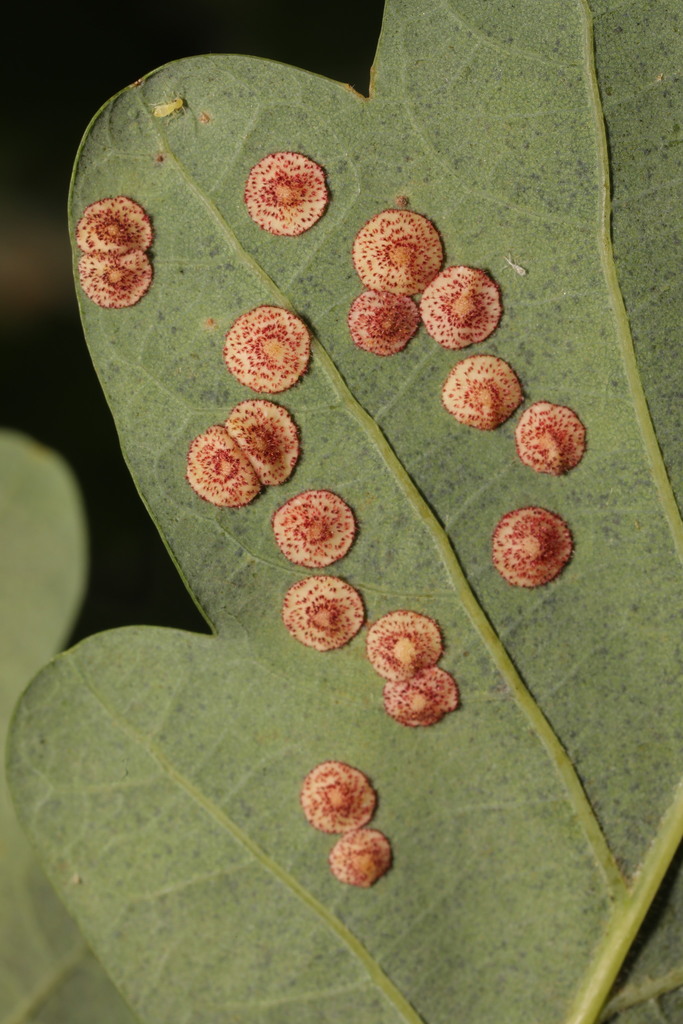
Neuroterus quercusbaccarum makes flat, disc-shaped galls on the undersides of oak leaves that turn from yellow-green to reddish and fall in autumn. The insect alternates between a leaf-galling generation and a catkin-galling generation, both of which develop on pedunculate or sessile oak.
Source: Wikipedia
How to recognize it
Galls appear as flat discs with a raised centre, slightly hairy, yellow-green at first and later reddish, on a short stalk.
Source: Wikipedia
Size
Each gall can grow up to about 6 mm across and has a single chamber for one larva.
Source: Wikipedia
Where it lives
Galls are found on the undersides of leaves and on male catkins of pedunculate or sessile oak trees. Young shoots at the base of older oaks often carry more galls than higher foliage.
Source: Wikipedia
What it eats
The bisexual generation emerges in June, mates, and the females lay fertilised eggs into the lower leaf surface. The asexual generation appears in April, laying unfertilised eggs in male catkins or young leaves.
Source: Wikipedia
Life cycle
Adults from the leaf-galling generation emerge in June, mate, and the females deposit eggs in leaf tissue for the next generation. Galls formed on leaves develop over winter and adult wasps emerge in April, starting the cycle again by laying eggs in catkins or leaf epidermis.
Source: Wikipedia
When you see it
Adults of the bisexual generation are seen in June. The asexual, smooth-surfaced galls appear in April.
Source: Wikipedia
Where it comes from
The species occurs throughout Europe, into Asia Minor and North Africa.
Source: Wikipedia
Lookalikes
Spangle galls can be mistaken for scale insects. Several different spangle-type galls occur on oak leaves, so careful inspection is needed.
Source: Wikipedia
More photos

Same family (Cynipidae)



Sources
- Wikipedia: https://en.wikipedia.org/wiki/Neuroterus_quercusbaccarum
Look it up elsewhere: GBIF · iNaturalist · BugGuide · ITIS · Wikipedia
Text written 2026-10-22 from the sources above and checked sentence by sentence against them. Data fetched 2026-10-22.