 Bug FAQ
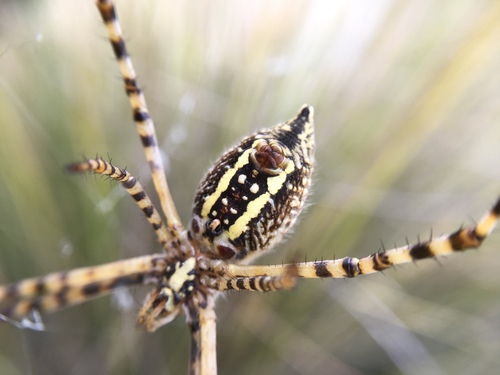
Banded Garden Spider
Argiope trifasciata · Order: Araneae · Family: Araneidae
Also called: Banded Garden Orb-web Spider, Whitebacked Garden Spider
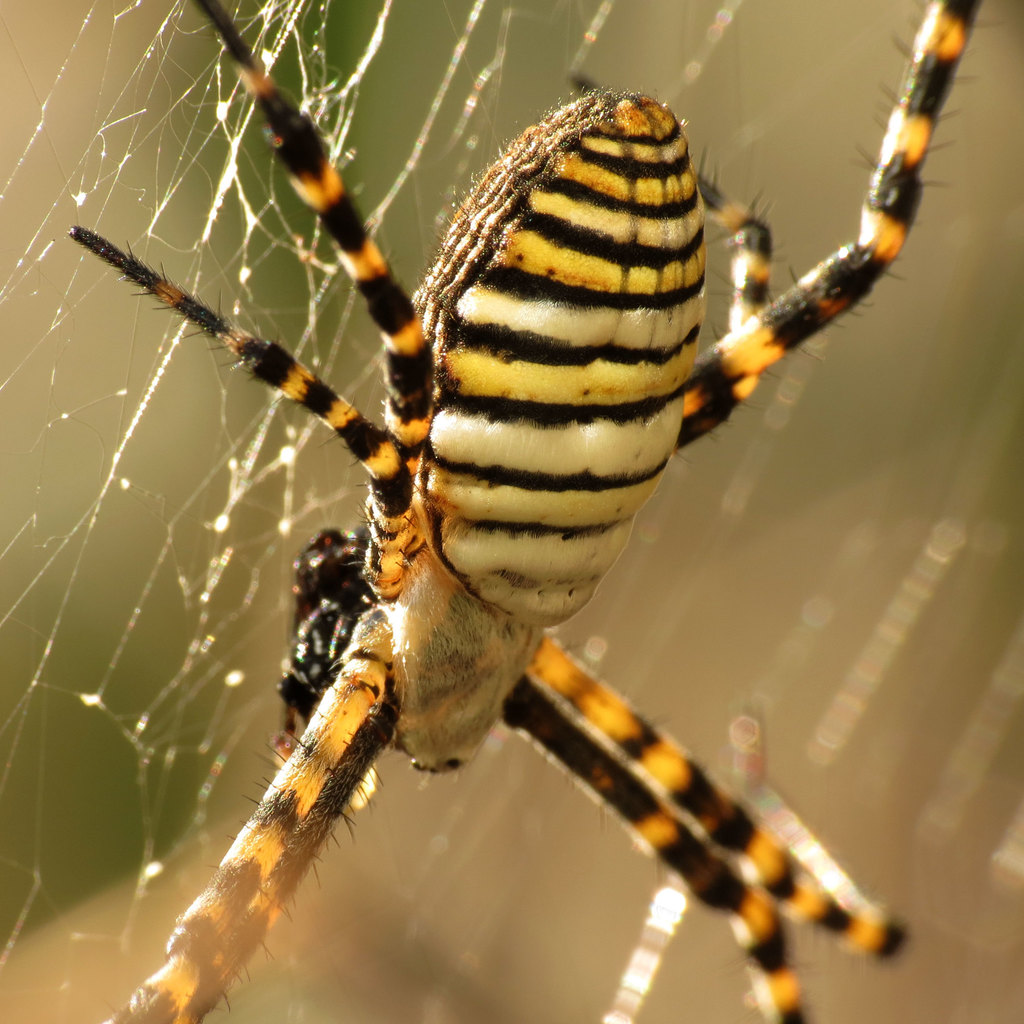
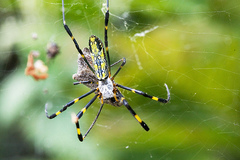
The banded garden spider hangs head-down at the centre of its orb web during the day. Its web often includes thicker, decorative silk bands called stabilimenta. It builds orb webs in wetlands, open grasslands and gardens, and is native to the Americas but now found worldwide.
Source: Wikipedia
How to recognize it
The spider hangs head-down at the hub of its web throughout the day. Some web sections have thicker, decorative silk strands called stabilimenta.
Source: Wikipedia
What it eats
It is active during the day and catches insects that get trapped in its web. Large prey such as paper wasps are quickly wrapped in silk and immobilised before being injected with toxic saliva.
Source: Wikipedia
Life cycle
In Illinois, it hatches in early summer and becomes noticeable by mid-August when its webs are fully formed. Females have been found surviving the warm winter months in Egypt, the type locality.
Source: Wikipedia
When you see it
Females can survive the relatively warm winter months in Egypt.
Source: Wikipedia
Where it comes from
Originally from North and South America, it has spread worldwide.
Source: Wikipedia
Lookalikes
A similar species, Argiope bruennichi, occurs in the Azores.
Source: Wikipedia
Where it is found in the US
Recorded in 49 of 51 states and DC. Most records: California, Ohio, Texas, Illinois, Florida, Minnesota, Virginia, Wisconsin.
Darker = more records. Counts are museum and citizen-science records, not population size.
Source: GBIF
Months it is reported in the US
Source: GBIF
More photos
Questions people ask
Are they harmful to gardens?
They are not reported to damage plants; they catch insects in their webs.
Source: Wikipedia
Same family (Araneidae)


Sources
- Wikipedia: https://en.wikipedia.org/wiki/Argiope_trifasciata
Look it up elsewhere: GBIF · iNaturalist · BugGuide · ITIS · Wikipedia
Text written 2026-10-22 from the sources above and checked sentence by sentence against them. Data fetched 2026-10-22.