 Bug FAQ
Banded Alder Borer
Rosalia funebris · Order: Coleoptera · Family: Cerambycidae
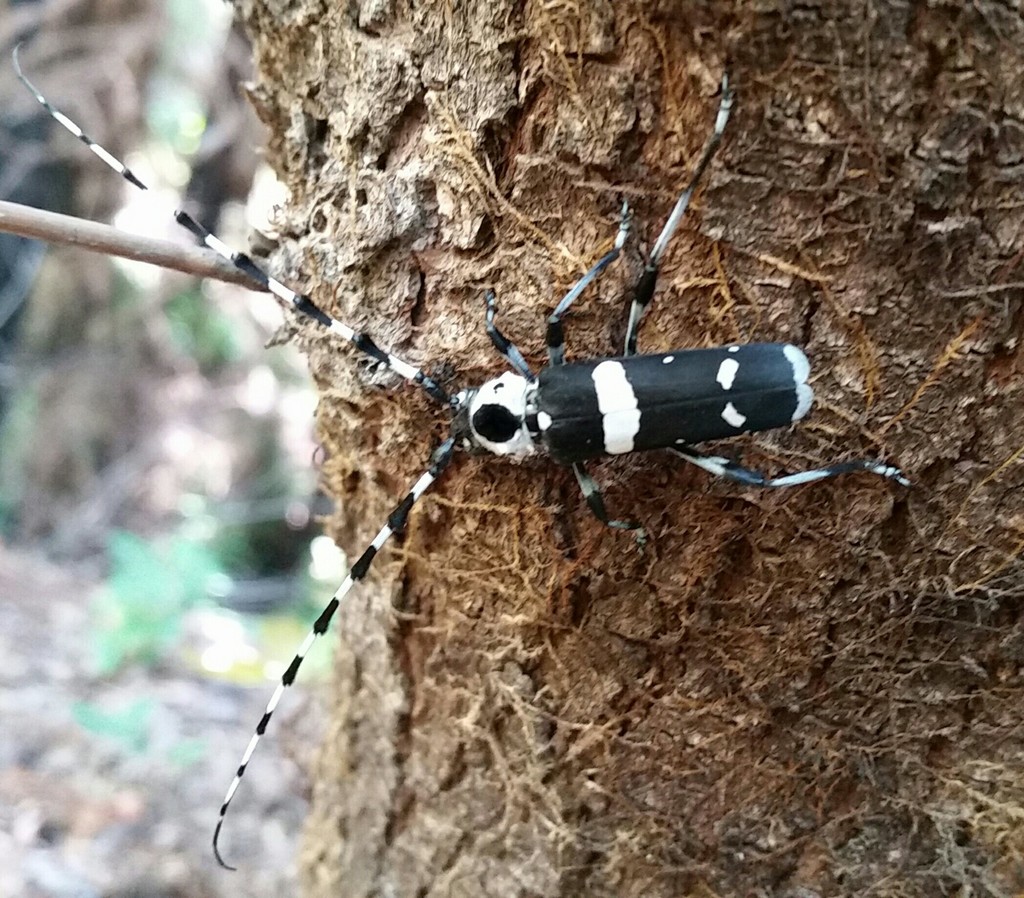
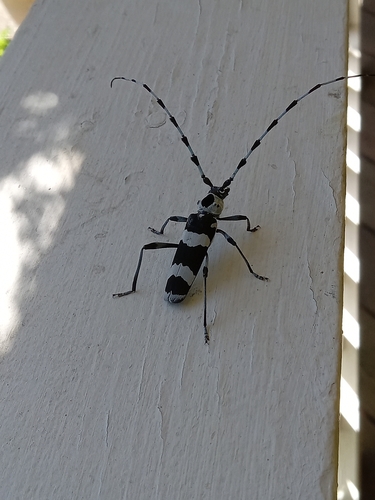
The banded alder borer is a long, narrow beetle that can reach about 38 mm (1.5 in) in length. Adults are seen on alder bark in spring and summer across western North America, from Alaska through California to New Mexico. Larvae bore into wood, while mature beetles feed on flowers.
Source: Wikipedia
Size
Adults may grow up to 38 mm (1.5 in) long.
Source: Wikipedia
Is it a pest in the house?
They are attracted to recently painted buildings.
Source: Wikipedia
Does it bite or sting?
When handled or threatened they produce a squeaky or hissing noise.
Source: Wikipedia
Where it lives
They are found on the bark of alder trees during spring and summer.
Source: Wikipedia
What it eats
Adult beetles usually feed on flowers, while the larvae eat wood.
Source: Wikipedia
Life cycle
Females lay eggs in crevices of hardwood bark, and the hatched larvae bore into the wood.
Source: Wikipedia
When you see it
They are most commonly observed in spring and summer.
Source: Wikipedia
Lookalikes
Similar species include Rosalia alpina and Rosalia batesi.
Source: Wikipedia
Where it is found in the US
Recorded in 9 of 51 states and DC. Most records: California, Washington, Oregon, Utah, Idaho, Arizona, New Mexico, Montana.
Darker = more records. Counts are museum and citizen-science records, not population size.
Source: GBIF
Status: native in North America; native in Canada. Source: iNaturalist
Months it is reported in the US
Source: GBIF
More photos
Questions people ask
How can I identify a banded alder borer?
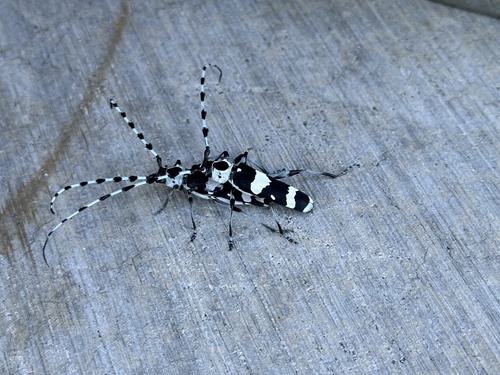
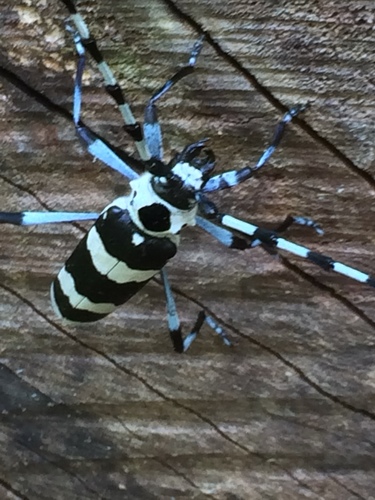
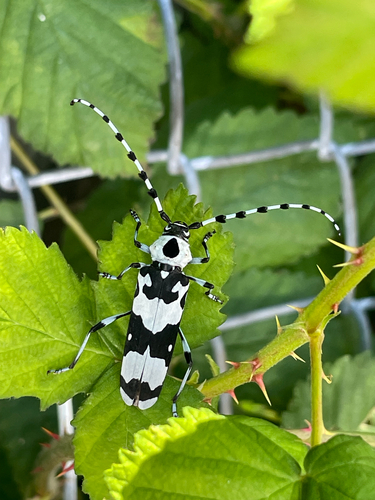
Look for a long, narrow beetle about 38 mm long with dark elytra bearing three white bands, a white pronotum with a large black spot, and antennae banded black and white.
Source: Wikipedia
When are banded alder borers active?
Adults are active on alder bark during the spring and summer months.
Source: Wikipedia
What does it do if I pick it up?
When handled or threatened it makes a squeaky noise like a running shoe, or a hiss like air let out of a bike tire.
Source: Wikipedia
Same family (Cerambycidae)
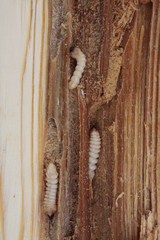 House LonghornHylotrupes bajulusCan damage your home
 Asian Longhorned BeetleAnoplophora glabripennisDamages trees, gardens or crops
 Red Milkweed BeetleTetraopes tetrophthalmus
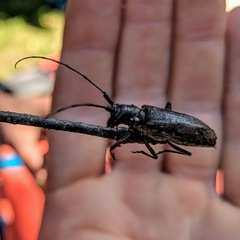 White-spotted SawyerMonochamus scutellatusCan damage your home
 Red Pine Longhorn BeetleStictoleptura rubra
 Spotted Longhorn BeetleRutpela maculataDamages trees, gardens or crops
Sources
- Wikipedia: https://en.wikipedia.org/wiki/Rosalia_funebris
Look it up elsewhere: GBIF · iNaturalist · BugGuide · ITIS · Wikipedia
Text written 2026-10-23 from the sources above and checked sentence by sentence against them. Data fetched 2026-10-23.