 Bug FAQ
Asian Hermit Spider
Nephilengys malabarensis · Order: Araneae · Family: Araneidae

Females grow to about 19 mm long, though an early description gave a size near 23 mm. They are often found inside human homes and sometimes near cave entrances, while being less common in rainforest.
Source: Wikipedia
How to recognize it
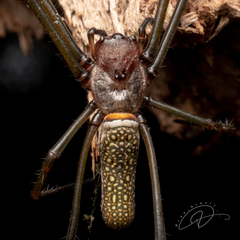
The legs and palps show alternating yellow and black rings, the body is dark red-brown and the underside is orange in live females.
Source: Wikipedia
Size
Female body length is roughly 19 mm, with older records noting about 23 mm.
Source: Wikipedia
Is it a pest in the house?
It is commonly found in human homes.
Source: Wikipedia
Where it lives
They commonly inhabit human dwellings and are also found at cave entrances; they are less frequent in rainforest.
Source: Wikipedia
More photos

Questions people ask
What do Asian hermit spiders look like?
Their legs and palps have yellow and black rings, the body is dark red-brown and the underside is orange in live females.
Source: Wikipedia
Same family (Araneidae)


.jpg)
.jpg)
Sources
- Wikipedia: https://en.wikipedia.org/wiki/Nephilengys_malabarensis
Look it up elsewhere: GBIF · iNaturalist · BugGuide · ITIS · Wikipedia
Text written 2026-10-23 from the sources above and checked sentence by sentence against them. Data fetched 2026-10-22.