 Bug FAQ
Asian Giant Hornet
Vespa mandarinia · Order: Hymenoptera · Family: Vespidae
Also called: Giant Asian Hornet, Giant Mandarin Hornet, Mandarin Giant Hornet, Mandarin Hornet
Source: Wikipedia
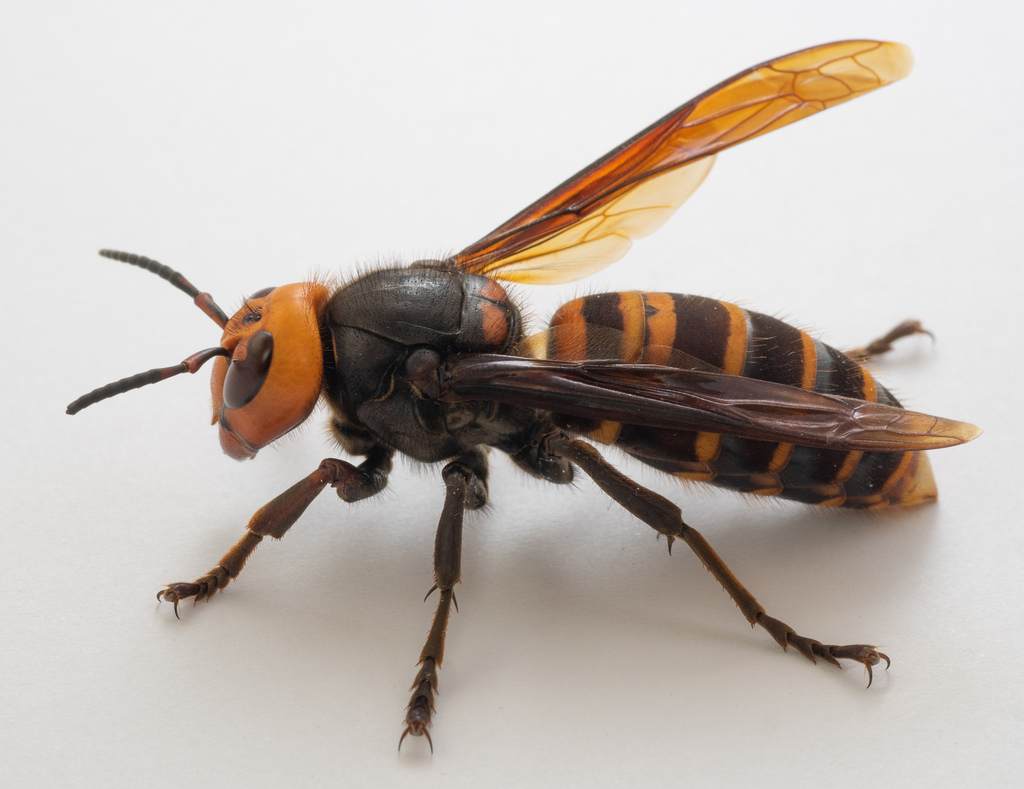
The Asian giant hornet is about 45 mm long with a 75 mm wingspan and a 6 mm stinger that delivers potent venom. It hunts large insects, especially honeybee colonies, and also feeds on tree sap and honey.
Source: Wikipedia
Size
Body length is about 45 mm (1¾ in) and wingspan around 75 mm (3 in); the stinger measures roughly 6 mm (¼ in).
Source: Wikipedia
Does it bite or sting?
The 6 mm stinger injects a potent venom containing mastoparan-M; multiple stings or allergic reactions can be fatal.
Source: Wikipedia
Where it lives
Prefers low-mountain forests and avoids plains and high-altitude areas. Nests are made by digging or using existing rodent tunnels, often near rotten pine roots.
Source: Wikipedia
What it eats
Feeds mainly on larger insects, other eusocial insect colonies, tree sap, and honey from bee colonies.
Source: Wikipedia
Lookalikes
Misidentifications often involve other wasps, bees, sawflies, horntails, mimicking flies, beetles, crickets, cicadas, or even toy models.
Source: Wikipedia
Where it is found in the US
Recorded in 1 of 51 states and DC. Most records: Washington.
Darker = more records. Counts are museum and citizen-science records, not population size.
Source: GBIF
Status: introduced in Canada; introduced in United States. Source: iNaturalist
Months it is reported in the US
Source: GBIF
More photos

Questions people ask
Can an Asian giant hornet sting kill a person?
Yes, its potent venom can be fatal if several hornets sting at once or if the person has a severe allergic reaction.
Source: Wikipedia
How can I recognize an Asian giant hornet?
Look for a light orange head, brown antennae with yellow-orange bases, bright forelegs with darker bases, and an abdomen with alternating dark brown/black and yellow-orange bands, the sixth segment being yellow.
Source: Wikipedia
What does the Asian giant hornet eat?
It preys on large insects, especially honeybee colonies, and also consumes tree sap and honey.
Source: Wikipedia
Same family (Vespidae)


Sources
- Wikipedia: https://en.wikipedia.org/wiki/Asian_giant_hornet
Look it up elsewhere: GBIF · iNaturalist · BugGuide · Wikipedia
Text written 2026-10-23 from the sources above and checked sentence by sentence against them. Data fetched 2026-10-22.