 Bug FAQ
Asian Ant Mantis
Odontomantis planiceps · Order: Mantodea · Family: Hymenopodidae

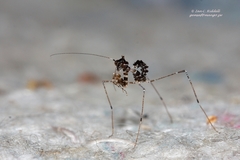
Young mantises (instars 1-3) are completely black with green bands on each thorax segment and mimic black ants. They are common in Southeast Asia, especially Malaysia, Indonesia, Hong Kong and Taiwan, and they thrive in urban gardens and ornamental plants.
Source: Wikipedia
How to recognize it
Juvenile mantises look like black ants, a form of Batesian mimicry that helps them avoid predators. From the first to third instar they are solid black with green bands at the edges of each thorax segment.
Source: Wikipedia
Size
Males reach about 1.4 cm, while females grow to roughly 2.0 cm as adults.
Source: Wikipedia
Where it lives
They are frequently found in urban gardens and on ornamental plants, adapting well to human-made environments.
Source: Wikipedia
What it eats
They sit motionless on leaves and wait for passing prey to capture.
Source: Wikipedia
Life cycle
Adults measure 1.4 cm (males) to 2.0 cm (females). The first three instars mimic black ants, providing protection during their most vulnerable stages.
Source: Wikipedia
Where it comes from
Their range covers much of Southeast Asia, from Malaysia and Indonesia up to Hong Kong and Taiwan.
Source: Wikipedia
More photos


Questions people ask
Why does the Asian ant mantis look like an ant?
The young mantis mimics black ants through its black color and green thorax bands, a defensive Batesian mimicry.
Source: Wikipedia
Where can I find an Asian ant mantis?
They are common throughout Southeast Asia, especially in Malaysia, Indonesia, Hong Kong and Taiwan, and they often live in urban gardens and on ornamental plants.
Source: Wikipedia
How big do Asian ant mantises get?
Adult males are about 1.4 cm long and females about 2.0 cm.
Source: Wikipedia
What do Asian ant mantises eat?
They wait motionless on leaves and catch passing insects as prey.
Source: Wikipedia
Same family (Hymenopodidae)




Sources
- Wikipedia: https://en.wikipedia.org/wiki/Odontomantis_planiceps
Look it up elsewhere: GBIF · iNaturalist · BugGuide · Wikipedia
Text written 2026-10-23 from the sources above and checked sentence by sentence against them. Data fetched 2026-10-22.