 Bug FAQ
Common Ghost Mantis
Phyllocrania paradoxa · Order: Mantodea · Family: Hymenopodidae
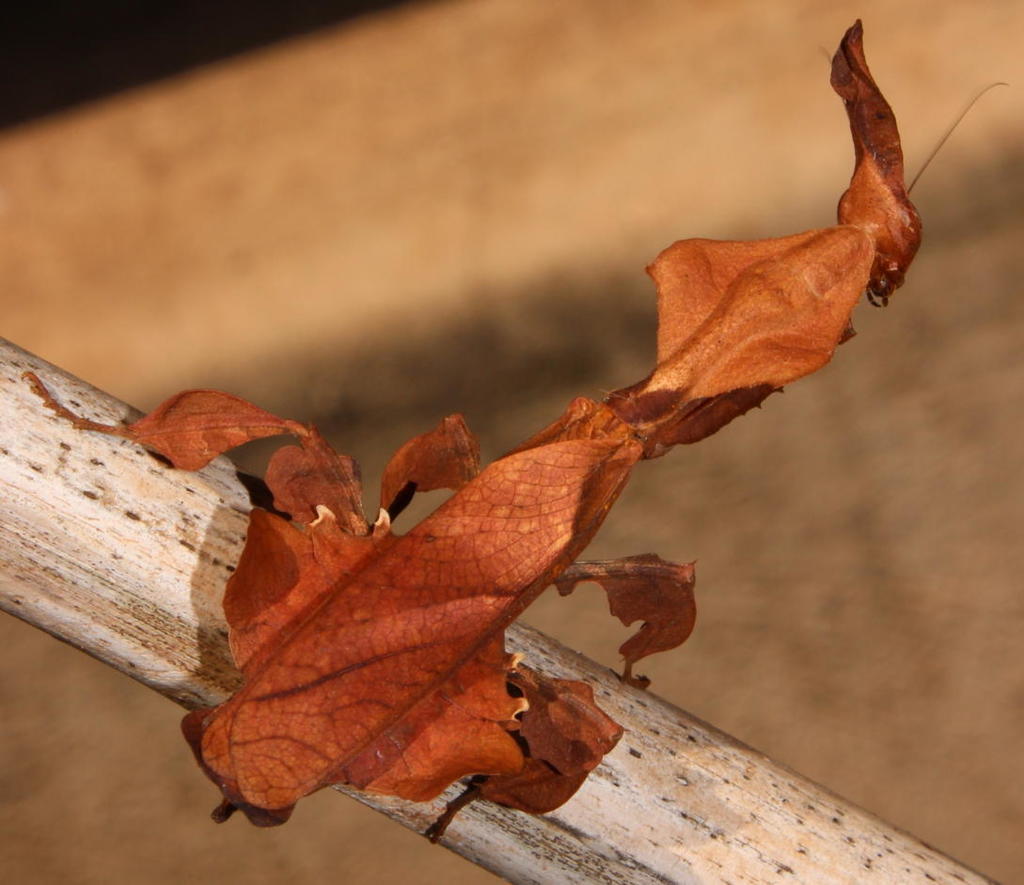
The common ghost mantis is a small praying mantis, only about 45-50 mm long. It is colored in brownish to greenish-gray shades and shaped like a dried leaf, with a flattened prothorax and leaf-like limb extensions. It lives in dry open areas on bushes, shrubs and trees across many African countries.
Source: Wikipedia
How to recognize it
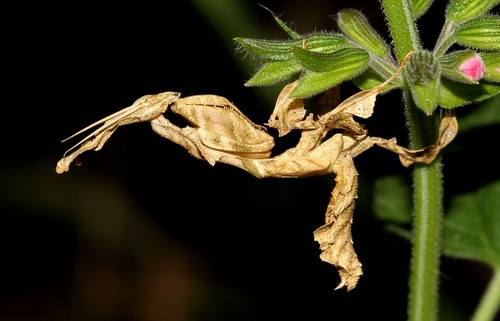
Colors range from very dark brown to greenish gray, and its body mimics a dead leaf with an elongated head, flattened prothorax, and leaf-like protrusions on the limbs.
Source: Wikipedia
Size
Adults grow to about 45 to 50 mm (1.8 to 2.0 in) in length.
Source: Wikipedia
Where it lives
Found in dry open habitats, often on bushes, shrubs, and trees.
Source: Wikipedia
Life cycle
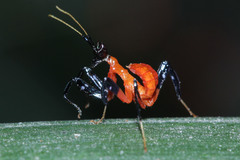
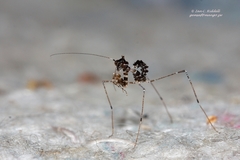
A single ootheca can contain up to 36 eggs that hatch into nymphs. First- and second-instar nymphs are dark and use ant mimicry for defense.
Source: Wikipedia
Where it comes from
Native to a wide range across Africa, including Angola, Kenya, Madagascar, South Africa, Tanzania, Uganda and many others.
Source: Wikipedia
Lookalikes
It is one of three species in the genus Phyllocrania, all sharing the distinctive dry-leaf camouflage.
Source: Wikipedia
More photos
Questions people ask
How big does the common ghost mantis get?
Adults reach about 45 to 50 mm (1.8 to 2.0 in) in length.
Source: Wikipedia
What does the ghost mantis look like?
It is brownish to greenish-gray and shaped like a dried leaf, with a flattened body and leaf-like limb extensions.
Source: Wikipedia
Where is the ghost mantis found?
It occurs across many African countries such as Angola, Kenya, Madagascar, South Africa, Tanzania and Uganda.
Source: Wikipedia
What habitats does the ghost mantis prefer?
It lives in dry open areas on bushes, shrubs and trees.
Source: Wikipedia
Same family (Hymenopodidae)
Sources
- Wikipedia: https://en.wikipedia.org/wiki/Phyllocrania_paradoxa
Look it up elsewhere: GBIF · iNaturalist · BugGuide · Wikipedia
Text written 2026-10-23 from the sources above and checked sentence by sentence against them. Data fetched 2026-10-23.