 Bug FAQ
Common Spiny Flower Mantis
Pseudocreobotra wahlbergi · Order: Mantodea · Family: Hymenopodidae
Also called: #9 Mantis, Bullseye Mantis, spiny flower mantis

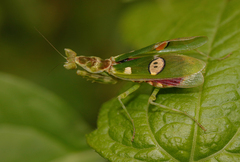
The common spiny flower mantis is about 40 mm long and comes in colors like light green, yellow, pink or red. It has a distinctive black-green-cream eyespot on its forewings surrounded by a green patch. Native to southern and eastern Africa, it mainly hunts flying insects and spiders but will eat almost any insect if needed.
Source: Wikipedia
How to recognize it
Its forewings bear a large eyespot that is black, green and cream with a surrounding green patch. The body colour varies; it can be light green, yellow, pink or red.
Source: Wikipedia
Size
Adults measure about 40 mm (roughly 1½ inches) in length.
Source: Wikipedia
What it eats
It prefers to catch flying insects and spiders, but will eat virtually any insect if those are unavailable.
Source: Wikipedia
Life cycle
Females have slightly shorter antennae, longer wings and require seven moults to reach maturity. Males lack wing spines, have eight abdominal segments, longer antennae, shorter wings and need six moults to mature.
Source: Wikipedia
Where it comes from
It is native to southern and eastern Africa.
Source: Wikipedia
More photos

Same family (Hymenopodidae)


Sources
- Wikipedia: https://en.wikipedia.org/wiki/Pseudocreobotra_wahlbergi
Look it up elsewhere: GBIF · iNaturalist · BugGuide · Wikipedia
Text written 2026-10-23 from the sources above and checked sentence by sentence against them. Data fetched 2026-10-23.