 Bug FAQ
Arrowhead Orbweaver
Verrucosa arenata · Order: Araneae · Family: Araneidae
Also called: Arrowhead Spider, orb weavers

The arrowhead orbweaver is a large, triangular-abdomined spider found across North America in wooded and shrubby areas. Females are 7 to 14 mm long, weigh up to 0.46 g, and have a white or yellow triangular abdomen. They spin sticky orb webs in late summer and early fall to catch flies and wasps.
Source: Wikipedia
How to recognize it
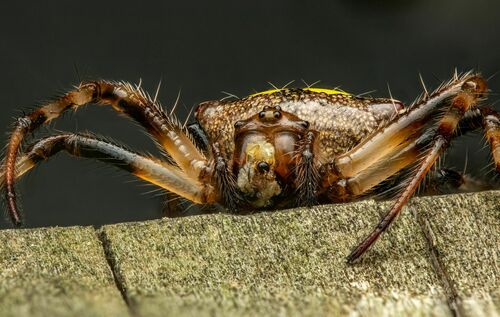
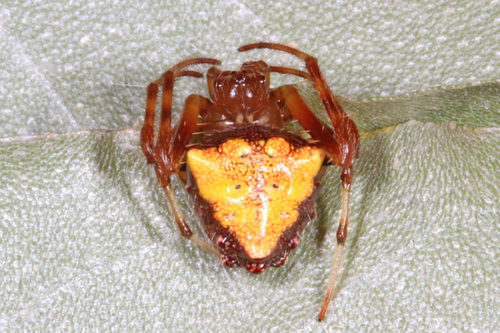
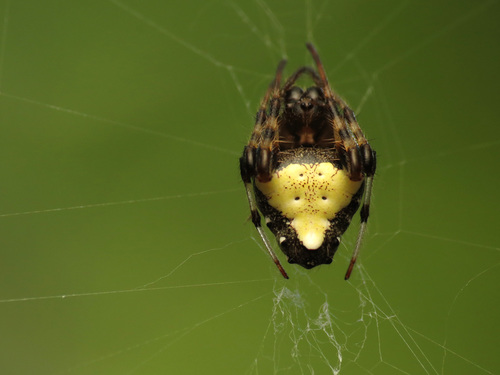
Females show a white or yellow triangle covering the whole abdomen.
Source: Wikipedia
Size
They are considered large spiders; females measure 7 to 14 mm in body length and weigh 0.05 to 0.46 g.
Source: Wikipedia
Where it lives
They live in a range of urban and rural sites with trees and bushes, often in humid understory that gets some sun.
Source: Wikipedia
What it eats
Their webs trap insects, especially flies and wasps.
Source: Wikipedia
Life cycle
Males are rarely seen except when courting or mating, and the spiders are active during the day.
Source: Wikipedia
When you see it
They are most commonly observed in late summer and early fall.
Source: Wikipedia
Where it comes from
The species occurs throughout North America.
Source: Wikipedia
Lookalikes
Unlike most orb-weavers with round abdomens, this spider has a pointed, arrow-shaped abdomen.
Source: Wikipedia
Where it is found in the US
Recorded in 30 of 51 states and DC. Most records: Virginia, North Carolina, Tennessee, Ohio, Maryland, Georgia, Missouri, Kentucky.
Darker = more records. Counts are museum and citizen-science records, not population size.
Source: GBIF
Status: native in North America; native in Canada; native in United States. Source: iNaturalist
Months it is reported in the US
Source: GBIF
More photos

Questions people ask
Where might I find an arrowhead orbweaver?
Look for them in wooded or shrubby areas during late summer and early fall, especially in humid understory with some sunlight.
Source: Wikipedia
Same family (Araneidae)


Sources
- Wikipedia: https://en.wikipedia.org/wiki/Verrucosa_arenata
Look it up elsewhere: GBIF · iNaturalist · BugGuide · ITIS · Wikipedia
Text written 2026-10-22 from the sources above and checked sentence by sentence against them. Data fetched 2026-10-22.