 Bug FAQ
Almond moth
Cadra cautella · Order: Lepidoptera · Family: Pyralidae
Also called: Dried Currant Moth, Dried-fruit Moth, fig-moth, tropical warehouse moth
Source: Wikipedia

Adult almond moths are light brown with gray hind wings and a short fringe along the wing edges; their wingspan ranges from 14 to 22 mm. The larvae develop on a variety of dry foods, especially wheat-based products, and can infest pantry items like dried fruits, nuts, beans, flour and other grains. They are found worldwide, thriving in tropical climates but spreading globally through stored-food shipments.
Source: Wikipedia
How to recognize it
Adults are mainly light brown, with smaller gray hind wings and a short fringe on the back edge of the wings.
Source: Wikipedia
Size
When the wings are spread, the wingspan measures between 14 and 22 mm.
Source: Wikipedia
Is it a pest in the house?
Commonly found in flour, bran, oats, other grains and dried fruits.
Source: Wikipedia
How to get rid of it
- Various control methods have been investigated.
- Research includes using natural predators and parasites to limit infestations.
Source: Wikipedia
Where it lives
They live in dry food products stored in warehouses or similar industrial settings.
Source: Wikipedia
What it eats
Larvae hatch on various dry foods, which become their primary food source. They grow fastest on wheat-based products.
Source: Wikipedia
Life cycle
Eggs hatch in about three and a half days, and larvae pass through five instars over 17 to 37 days. The pupal stage lasts roughly seven days under optimal temperature and humidity.
Source: Wikipedia
Where it comes from
Almond moths occur worldwide. They prefer tropical climates but have spread globally via international shipment of dry goods.
Source: Wikipedia
Lookalikes
Other common names like dried currant moth or fig moth may cause confusion with related species such as Cadra figulilella and Cadra calidella.
Source: Wikipedia
Where it is found in the US
Recorded in 8 of 51 states and DC. Most records: New Jersey, Georgia, North Carolina, California, Idaho, Mississippi, Texas, Connecticut.
Darker = more records. Counts are museum and citizen-science records, not population size.
Source: GBIF
Status: introduced in Canada; native in North America. Source: iNaturalist
Months it is reported in the US
Source: GBIF
Questions people ask
How can I identify an almond moth?
Look for a light-brown adult with gray hind wings, a short fringe on the wing edges, and a wingspan of 14 to 22 mm.
Source: Wikipedia
What foods does the almond moth infest?
The larvae feed on dry foods such as dried fruits, nuts, beans, flour, grains and especially wheat-based products.
Source: Wikipedia
How can I control an almond moth infestation?
Control strategies include various methods under study, notably the use of natural predators and parasites.
Source: Wikipedia
Where is the almond moth found?
It occurs worldwide, thriving in tropical climates but spreading globally through stored-food shipments.
Source: Wikipedia
Same family (Pyralidae)
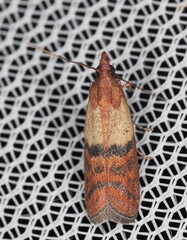 Indian-Meal MothPlodia interpunctellaCan damage your home
 Greater Wax MothGalleria mellonella
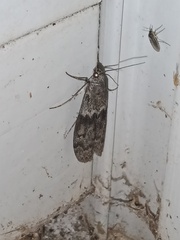 Mediterranean Flour MothEphestia kuehniellaCan damage your home
 Meal mothPyralis farinalisDamages trees, gardens or crops
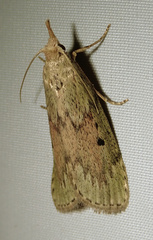 Bee MothAphomia sociellaNuisance, not dangerous
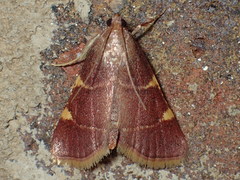 Yellow-fringed Dolichomia MothHypsopygia olinalis
Sources
- Wikipedia: https://en.wikipedia.org/wiki/Almond_moth
Look it up elsewhere: GBIF · iNaturalist · BugGuide · Wikipedia
Text written 2026-10-29 from the sources above and checked sentence by sentence against them. Data fetched 2026-10-29.