 Bug FAQ
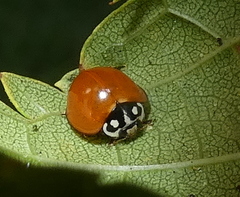
Aiolocaria hexaspilota
Aiolocaria hexaspilota · Order: Coleoptera · Family: Coccinellidae

Adults can grow up to about 113 mm long. In early autumn they leave sunny forest areas and move to warm, sun-lit rocky slopes or buildings, where they shelter in winter in groups of hundreds. They are specialized predators of leaf beetles (chrysomelids).
Source: Wikipedia
Size
Adults can reach up to about 113 mm in length.
Source: Wikipedia
Is it a pest in the house?
In winter they seek shelter in rock crevices or inside human dwellings, forming aggregations of several hundred individuals.
Source: Wikipedia
Where it lives
In early autumn they migrate from sunny forest habitats to well-insolated rocky slopes or to buildings.
Source: Wikipedia
What it eats
They are specialized predators that feed on chrysomelid beetles.
Source: Wikipedia
Life cycle
The species is univoltine, producing one brood per year; adults cluster in winter to keep warm and then mate in spring before dispersing.
Source: Wikipedia
When you see it
They migrate in early autumn and mate in spring before dispersing.
Source: Wikipedia
Lookalikes
It was once also described under the name Aiolocaria mirabilis.
Source: Wikipedia
More photos


Questions people ask
What do Aiolocaria hexaspilota beetles eat?
They specialize in preying on leaf beetles (chrysomelids).
Source: Wikipedia
Why do they gather inside houses?
In winter they look for shelter and cluster in human buildings as well as rock crevices.
Source: Wikipedia
Same family (Coccinellidae)



Sources
- Wikipedia: https://en.wikipedia.org/wiki/Aiolocaria
Look it up elsewhere: GBIF · iNaturalist · BugGuide · Wikipedia
Text written 2026-10-23 from the sources above and checked sentence by sentence against them. Data fetched 2026-10-23.