 Bug FAQ
Agapanthia irrorata
Agapanthia irrorata · Order: Coleoptera · Family: Cerambycidae
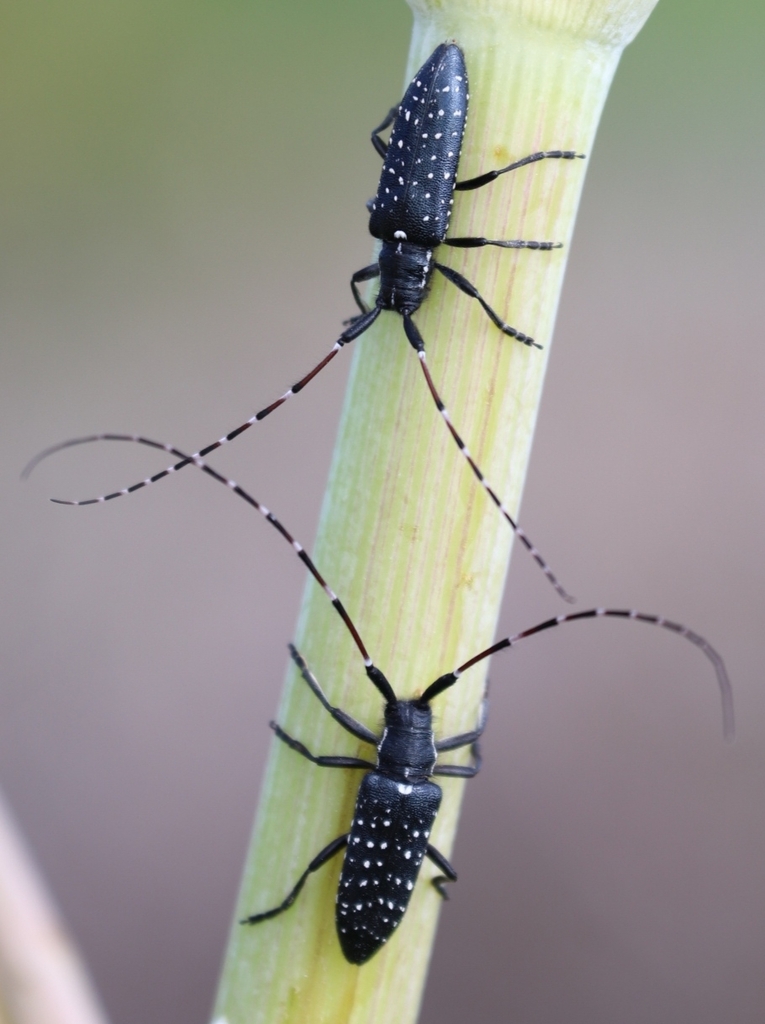
Agapanthia irrorata is a black beetle covered with yellowish-white dots. Adults are 13 to 23 mm long and are active in flight from April to June. It lives in North Africa and southern Europe, including Portugal and Spain, and feeds on a variety of herbaceous plants such as Carduus, Daucus, Ferula, Onopordum and Salvia.
Source: Wikipedia
How to recognize it
The beetle is black with yellowish-white dots.
Source: Wikipedia
Size
It measures between 13 and 23 mm in length.
Source: Wikipedia
Where it lives
It is found in North Africa and southern Europe, including Portugal and Spain.
Source: Wikipedia
What it eats
It feeds on many herbaceous plants, for example Carduus, Daucus, Ferula, Onopordum and Salvia species.
Source: Wikipedia
Life cycle
Adults fly from April through June.
Source: Wikipedia
When you see it
Their flight period is April to June.
Source: Wikipedia
Where it comes from
Its native range includes North Africa and southern Europe, such as Portugal and Spain.
Source: Wikipedia
Questions people ask
What does Agapanthia irrorata look like?
It is a black beetle with yellowish-white dots and measures 13 to 23 mm long.
Source: Wikipedia
Where can I find Agapanthia irrorata?
It occurs in North Africa and southern Europe, including Portugal and Spain.
Source: Wikipedia
What plants does Agapanthia irrorata eat?
It feeds on various herbaceous plants such as Carduus, Daucus, Ferula, Onopordum and Salvia.
Source: Wikipedia
Same family (Cerambycidae)
 House LonghornHylotrupes bajulusCan damage your home
 Asian Longhorned BeetleAnoplophora glabripennisDamages trees, gardens or crops
 Red Milkweed BeetleTetraopes tetrophthalmus
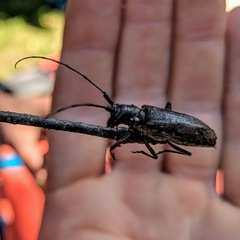 White-spotted SawyerMonochamus scutellatusCan damage your home
 Red Pine Longhorn BeetleStictoleptura rubra
 Spotted Longhorn BeetleRutpela maculataDamages trees, gardens or crops
Sources
- Wikipedia: https://en.wikipedia.org/wiki/Agapanthia_irrorata
Look it up elsewhere: GBIF · iNaturalist · BugGuide · Wikipedia
Text written 2026-10-23 from the sources above and checked sentence by sentence against them. Data fetched 2026-10-23.