 Bug FAQ
African Hermit Spider
Nephilingis cruentata · Order: Araneae · Family: Araneidae
Also called: Hermit Spider
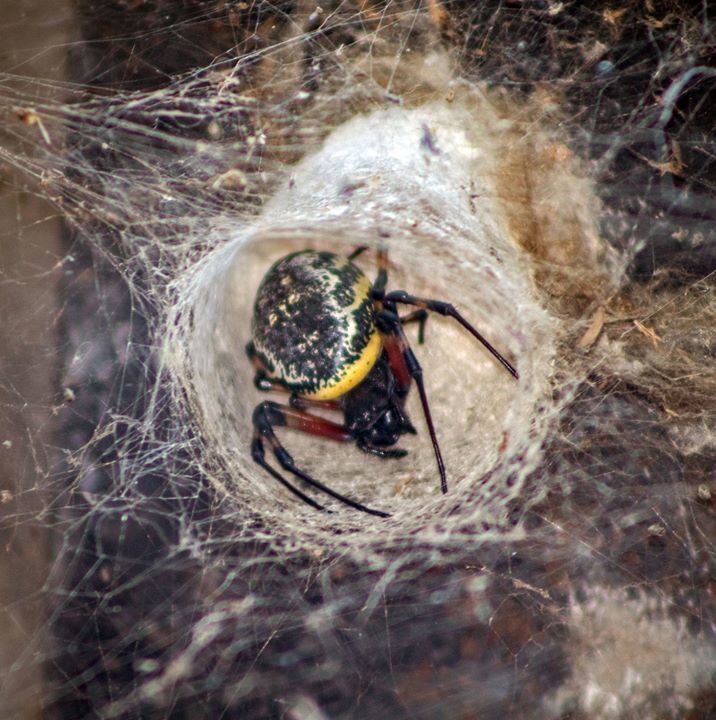
Females are about 20-25 mm long while males are usually no more than 5 mm. They build large, asymmetrical white orb webs up to 1.5 m across, often on tree trunks, walls, rocks or under roof overhangs, with a funnel-shaped retreat. The species is native to tropical and subtropical Africa and has been introduced to parts of South America.
Source: Wikipedia
How to recognize it
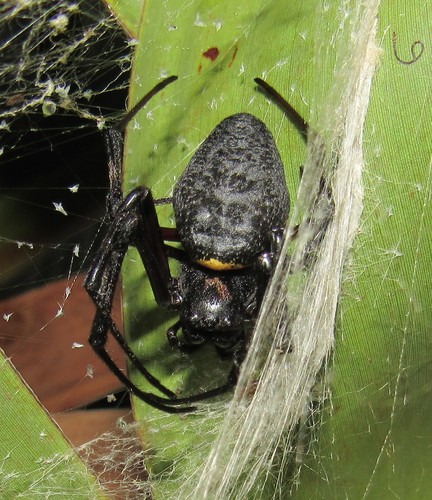
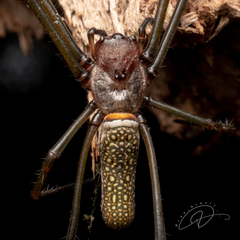
Females have a large, heart-shaped abdomen that can be olive-brown, cream or earthy grey, and the underside shows a reddish-orange mark that helps tell them apart from golden orb weavers.
Source: Wikipedia
Size
Female body length is 20-25 mm; males are typically 5 mm or less.
Source: Wikipedia
Where it lives
They spin asymmetrical white orb webs against tree trunks, walls, large rocks, or under roof overhangs, with a side funnel retreat.
Source: Wikipedia
What it eats
Their large webs, 1-1.5 m in diameter, are used to catch prey.
Source: Wikipedia
Where it comes from
Found in tropical and subtropical Africa and in limited areas of Brazil, northern Colombia and Paraguay, likely introduced by humans in the late 1800s.
Source: Wikipedia
Lookalikes
A reddish-orange marking on the underside distinguishes them from the similar golden orb weaver.
Source: Wikipedia
More photos
Same family (Araneidae)

Sources
- Wikipedia: https://en.wikipedia.org/wiki/Nephilingis_cruentata
Look it up elsewhere: GBIF · iNaturalist · BugGuide · ITIS · Wikipedia
Text written 2026-10-22 from the sources above and checked sentence by sentence against them. Data fetched 2026-10-22.