 Bug FAQ
Acanthinodera cumingii
Acanthinodera cumingii · Order: Coleoptera · Family: Cerambycidae

Males are light-brown, furry and 5 to 6 cm long, while females are black, 8 to 9 cm on average and can exceed 12 cm. They live from sea level up into the Precordillera hills of central Chile, and their larvae develop inside many native and invasive trees, playing a key role in dead-wood decomposition. Development from egg to adult can take up to six years, with larvae growing as large as 13 cm.
Source: Wikipedia
How to recognize it
When disturbed they hiss by rubbing their rear legs against the wing covers. Males are active at night and can fly; females are active by day and cannot fly.
Source: Wikipedia
Size
Males measure 5 to 6 cm, are light brown and furry. Females are black, usually 8 to 9 cm long, but some reach over 12 cm.
Source: Wikipedia
Does it bite or sting?
Their legs end in large claws, making them hard to remove once they grip bark, clothing, or skin.
Source: Wikipedia
Where it lives
They are found from sea level up to the Precordillera hills. Larvae live in about 30 species of trees, both native and invasive.
Source: Wikipedia
What it eats
They help decompose dead wood, contributing to forest nutrient cycles.
Source: Wikipedia
Life cycle
It can take up to six years for an egg to develop into an adult, depending on humidity and food availability. Larvae can grow as large as 13 cm in length.
Source: Wikipedia
When you see it
Males are nocturnal and can fly, while females are diurnal and do not fly.
Source: Wikipedia
Where it comes from
The beetle is endemic to central Chile, from the Coquimbo Region south to the La Araucanía Region.
Source: Wikipedia
More photos


Questions people ask
How big are they?
Males are 5 to 6 cm long; females are usually 8 to 9 cm but can exceed 12 cm.
Source: Wikipedia
Where are they found?
They are native to central Chile, from Coquimbo down to La Araucanía.
Source: Wikipedia
What sound do they make when disturbed?
They hiss by rubbing their rear legs along the wing covers.
Source: Wikipedia
Same family (Cerambycidae)
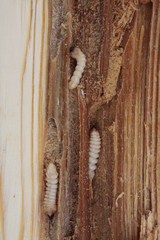 House LonghornHylotrupes bajulusCan damage your home
 Asian Longhorned BeetleAnoplophora glabripennisDamages trees, gardens or crops
 Red Milkweed BeetleTetraopes tetrophthalmus
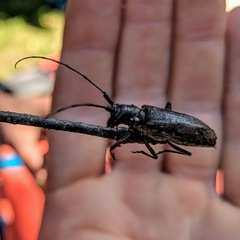 White-spotted SawyerMonochamus scutellatusCan damage your home
 Red Pine Longhorn BeetleStictoleptura rubra
 Spotted Longhorn BeetleRutpela maculataDamages trees, gardens or crops
Sources
- Wikipedia: https://en.wikipedia.org/wiki/Acanthinodera
Look it up elsewhere: GBIF · iNaturalist · BugGuide · Wikipedia
Text written 2026-10-23 from the sources above and checked sentence by sentence against them. Data fetched 2026-10-23.