 Bug FAQ
Abandoned-web Orb-weaver
Parawixia dehaani · Order: Araneae · Family: Araneidae
Also called: Two-Horned Village Spider
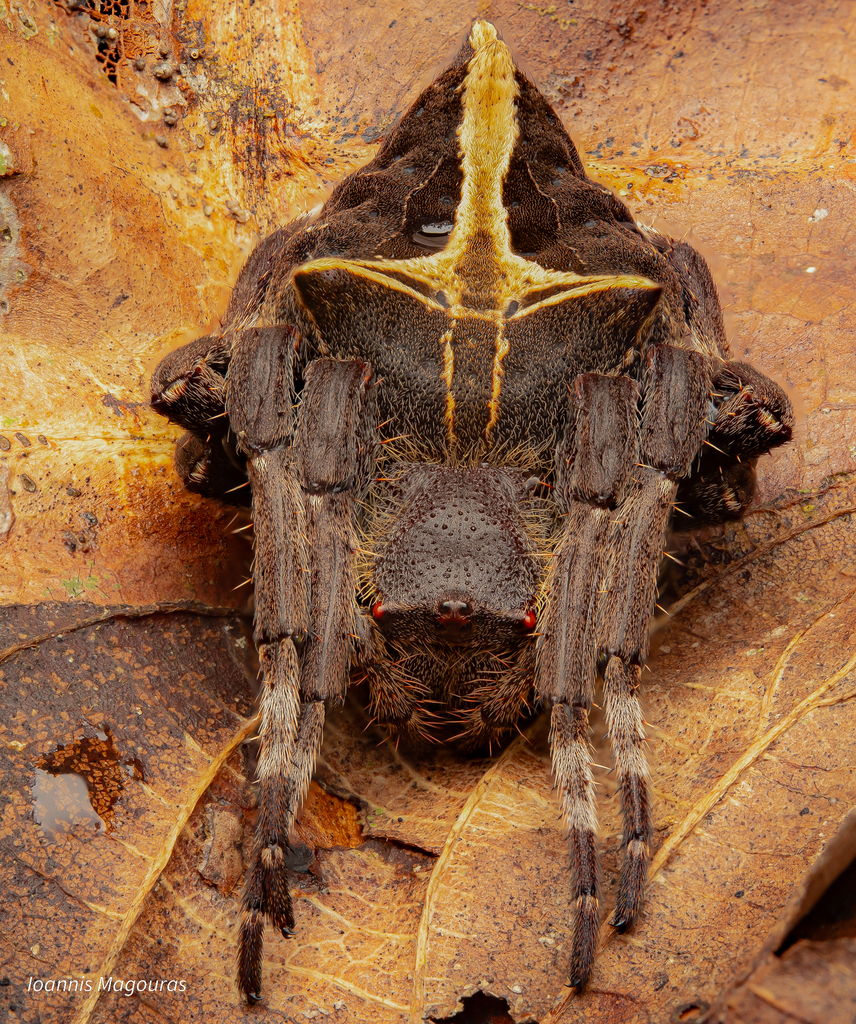
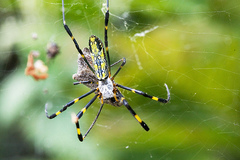
The female Abandoned-web Orb-weaver is a large, dark brown spider with a triangular abdomen that has sharp spikes. It is nocturnal and mainly catches moths for food.
Source: Wikipedia
How to recognize it
The most noticeable field characteristic is a triangular abdomen with sharp spikes at the corners.
Source: Wikipedia
Size
Females are large and dark brown.
Source: Wikipedia
What it eats
It is nocturnal and feeds mainly on moths.
Source: Wikipedia
Lookalikes
A close relative, Parawixia bistriata, occurs mainly in South America.
Source: Wikipedia
Questions people ask
What does the Abandoned-web Orb-weaver look like?
Females are large, dark brown spiders with a triangular abdomen that has sharp spikes at the corners.
Source: Wikipedia
Where might I find this spider?
It lives in gardens, disturbed areas and nearby bushland within its range from India to Australia and the Philippines, and has also been seen in Pakistan.
Source: Wikipedia
Is there a similar spider in other regions?
A close relative, Parawixia bistriata, is found mainly in South America.
Source: Wikipedia
Same family (Araneidae)


Sources
- Wikipedia: https://en.wikipedia.org/wiki/Parawixia_dehaani
Look it up elsewhere: GBIF · iNaturalist · BugGuide · ITIS · Wikipedia
Text written 2026-10-23 from the sources above and checked sentence by sentence against them. Data fetched 2026-10-22.