 Bug FAQ
24-spot Ladybird
Subcoccinella vigintiquatuorpunctata · Order: Coleoptera · Family: Coccinellidae
Also called: 24-spotted Lady Beetle, 24-spotted Ladybird Beetle, Alfalfa Lady Beetle, Alfalfa Ladybug
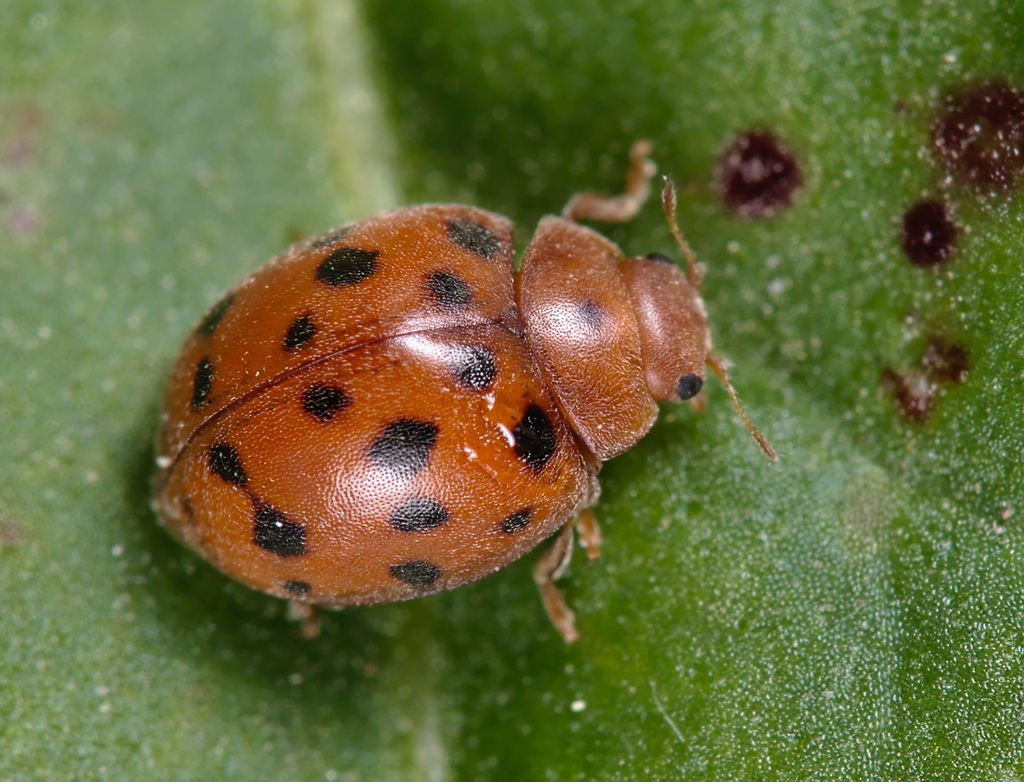
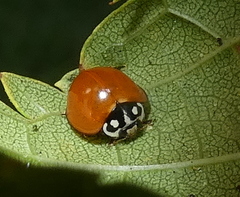
The 24-spot ladybird is a tiny orange beetle about 3 to 4 mm long with roughly 20 to 24 black spots on its wing covers. It lives in many open habitats across Europe and Asia, laying eggs in May and the new adults are seen from late spring through autumn.
Source: Wikipedia
How to recognize it
The beetle has a classic dome-shaped ladybird outline, dark orange body, legs and antennae, and black spots that usually number between 20 and 24.
Source: Wikipedia
Size
Adults measure 3 to 4 mm, while larvae are slightly larger at 4 to 6 mm.
Source: Wikipedia
Where it lives
It is found in steppe, grassland, quarries, wasteland, forest edges, riverbanks and other open areas of central Europe.
Source: Wikipedia
What it eats
Larvae eat the mycelium of powdery mildew fungi, especially Podosphaera on oak and ash trees, as well as on grasses and some legumes and borages. The insects can carry fungal spores on their bodies.
Source: Wikipedia
Life cycle
Eggs are laid in May; larvae develop for about six weeks before becoming adults. Adults are active from late spring until October or November.
Source: Wikipedia
When you see it
You can see adults from late spring through the autumn months.
Source: Wikipedia
Where it comes from
Its native range spans Europe, North Africa, much of Russia, Central Asia, the Middle East, and parts of East Asia including China and Korea.
Source: Wikipedia
Lookalikes
A similar small ladybird, Cynegetis impunctata, is browner and lacks spots.
Source: Wikipedia
Where it is found in the US
Recorded in 13 of 51 states and DC. Most records: Ohio, Michigan, Pennsylvania, Colorado, Illinois, Massachusetts, Indiana, New York.
Darker = more records. Counts are museum and citizen-science records, not population size.
Source: GBIF
Status: introduced in North America; introduced in United States; introduced in Canada. Source: iNaturalist
Months it is reported in the US
Source: GBIF
More photos
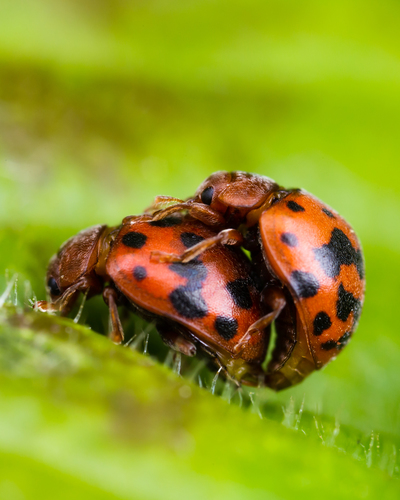

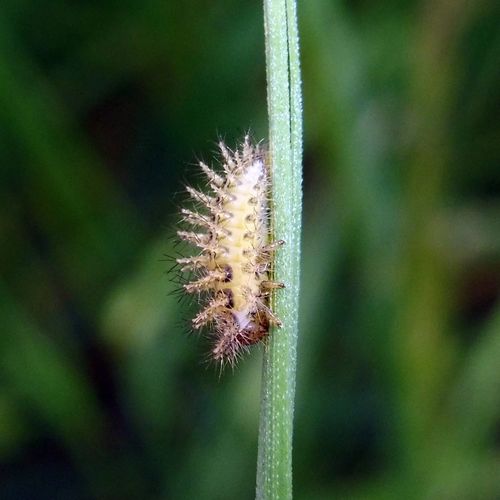
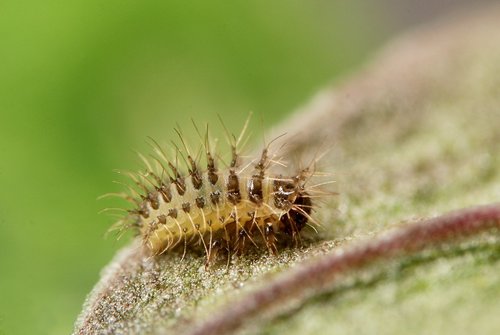
Questions people ask
What do 24-spot ladybird larvae eat?
They feed on the mycelium of powdery mildew fungi, especially Podosphaera on oak and ash trees and on some grasses and legumes.
Source: Wikipedia
When can I see adult 24-spot ladybirds?
Adults are present from late spring until the autumn, typically May through October or November.
Source: Wikipedia
How can I tell a 24-spot ladybird from similar species?
It is a tiny orange beetle with about 20 to 24 black spots, while the look-alike Cynegetis impunctata is browner and has no spots.
Source: Wikipedia
Same family (Coccinellidae)

Sources
- Wikipedia: https://en.wikipedia.org/wiki/Subcoccinella_vigintiquatuorpunctata
Look it up elsewhere: GBIF · iNaturalist · BugGuide · ITIS · Wikipedia
Text written 2026-10-22 from the sources above and checked sentence by sentence against them. Data fetched 2026-10-22.