 Bug FAQ
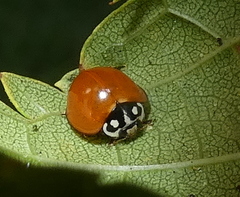
10-spot Ladybird
Adalia decempunctata · Order: Coleoptera · Family: Coccinellidae
Also called: Ten-spot Ladybird, 10-spotted Lady Beetle, Ten-spotted Lady Beetle, Ten-spotted Ladybird Beetle

The 10-spot ladybird is a small beetle about 3.5 to 5 mm long and shows a wide range of colour forms and spot patterns. It lives in many habitats such as forests, parks, gardens and steppe areas, where it hunts aphids on trees, bushes and grasses. Adults spend the winter in leaf litter and fallen leaves.
Source: Wikipedia
How to recognize it
Individuals can be red, orange or brown and may have from zero up to about twelve dark spots on the wing covers, with rare records of up to fifteen.
Source: Wikipedia
Size
Adults reach a body length of roughly 3.5 to 5 mm (0.14 to 0.20 in).
Source: Wikipedia
Where it lives
You can find it on bushes, deciduous trees, grasses, under bark, in moss, leaf litter, brushwood, coarse woody debris and alluvial soil.
Source: Wikipedia
What it eats
Both larvae and adults feed on aphids that live on trees and bushes.
Source: Wikipedia
Life cycle
Adults overwinter in leaf litter and among fallen leaves.
Source: Wikipedia
When you see it
Adults spend the winter months hidden in litter and fallen leaves.
Source: Wikipedia
Status: introduced in Canada. Source: iNaturalist
More photos


Questions people ask
Are they a problem for my garden?
No, they actually help by eating aphids that can damage plants.
Source: Wikipedia
Same family (Coccinellidae)

Sources
- Wikipedia: https://en.wikipedia.org/wiki/Adalia_decempunctata
Look it up elsewhere: GBIF · iNaturalist · BugGuide · Wikipedia
Text written 2026-10-22 from the sources above and checked sentence by sentence against them. Data fetched 2026-10-22.