 Bug FAQ
Zebra Longwing
Heliconius charithonia · Order: Lepidoptera · Family: Nymphalidae
Also called: Zebra Heliconian, Zebra Long Wing

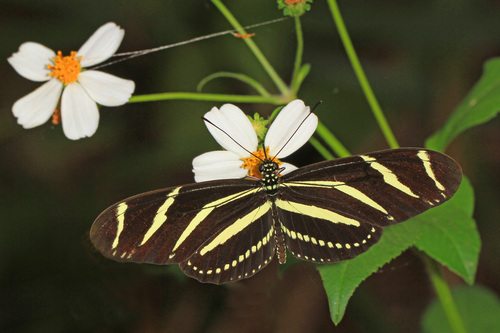
Adult Zebra Longwings have a wingspan of about 7 to 10 cm and display bold black, white and yellow stripes on the upper side of their wings. They live in tropical hammocks, moist forests, edges and fields, and roost together in groups of up to 60 at night for safety. Adults feed on both nectar and pollen, while the caterpillars eat several species of passionflower.
Source: Wikipedia
How to recognize it
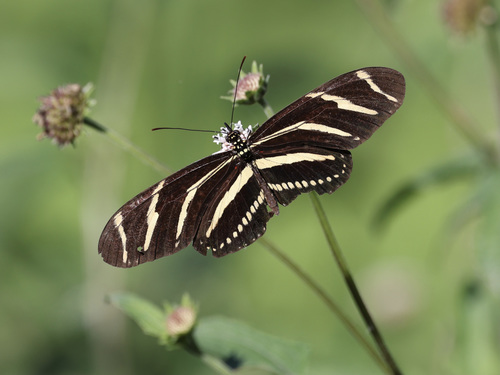
The dorsal wing surface is black with narrow white and yellow stripes, and the underside is similar but paler and has red spots. The striking black-and-white pattern warns predators that the butterfly is unpalatable.
Source: Wikipedia
Size
Adults are medium-sized butterflies with a wingspan ranging from 72 to 100 mm (about 2.8 to 3.9 inches).
Source: Wikipedia
Where it lives
They are found in tropical hammocks, moist forests, forest edges, and open fields. At night they gather in communal roosts of up to 60 individuals for protection.
Source: Wikipedia
What it eats
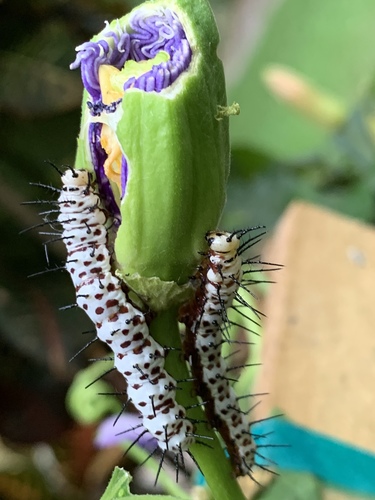
Adult Zebra Longwings feed on nectar and also collect pollen, which is unusual for butterflies. Caterpillars eat various passionflower species such as yellow, corky-stemmed, and two-flower passionflower.
Source: Wikipedia
Life cycle
Adults select their home ranges based on the availability of pollen-bearing plants.
Source: Wikipedia
When you see it
During warm months some individuals migrate northward to places like New Mexico, South Carolina, and Nebraska.
Source: Wikipedia
Lookalikes
Their range overlaps with other butterflies such as the Gulf Fritillary, which can cause identification confusion.
Source: Wikipedia
Where it is found in the US
Recorded in 19 of 51 states and DC. Most records: Florida, Texas, Georgia, South Carolina, Alabama, Louisiana, Mississippi, North Carolina.
Darker = more records. Counts are museum and citizen-science records, not population size.
Source: GBIF
Status: native in North America. Source: iNaturalist
Months it is reported in the US
Source: GBIF
More photos

Questions people ask
Are they a pest for gardens or crops?
They feed on passionflower plants, but there is no information that they damage crops or gardens.
Source: Wikipedia
Can they be confused with other butterflies?
Yes, they share parts of their range with species like the Gulf Fritillary, which can lead to misidentification.
Source: Wikipedia
Same family (Nymphalidae)






Sources
- Wikipedia: https://en.wikipedia.org/wiki/Heliconius_charithonia
Look it up elsewhere: GBIF · iNaturalist · BugGuide · ITIS · Wikipedia
Text written 2026-10-22 from the sources above and checked sentence by sentence against them. Data fetched 2026-10-22.