 Bug FAQ
Painted Lady
Vanessa cardui · Order: Lepidoptera · Family: Nymphalidae
Also called: Cosmopolitan Butterfly, Painted Lady Butterfly, Thistle Butterfly
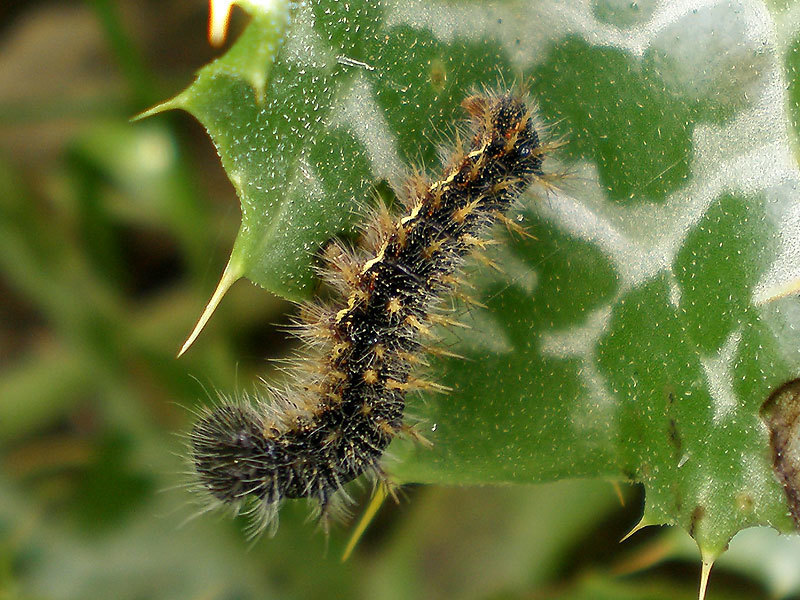
Painted ladies have reddish-ochre upper wings with black bands and spots, and the hind wings show black patches and rows of lunules. They live in sunny open areas, often near flowers, and also use sheltered hedgerows; they are found on every continent except Antarctica. Caterpillars eat thistles and related plants, while adults sip nectar and honeydew; they migrate seasonally, sometimes traveling thousands of kilometres.
Source: Wikipedia
How to recognize it
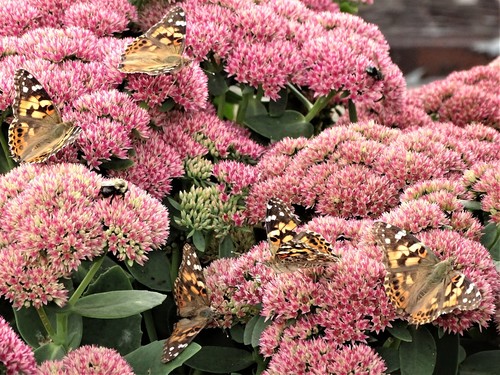
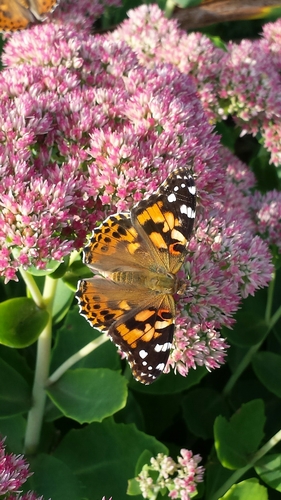
The forewing shows an outward-slanting broken black band and a short white streak near the apex, plus a row of four rounded spots; the hindwing has a blackish patch, a curved discal band, and several rows of lunules and spots.
Source: Wikipedia
Size
Upper side ground colour is reddish-ochreous with olive-brown bases; wing edges have alternating black and white cilia.
Source: Wikipedia
Where it lives
They prefer bright, open habitats with flowers and clovers, and will rest in small ground depressions on overcast days. They also establish territories in hedgerow-sheltered areas.
Source: Wikipedia
What it eats
Caterpillars feed on plants in the aster family such as thistles, knapweeds, burdock and sunflowers. Adults drink flower nectar and aphid honeydew.
Source: Wikipedia
Life cycle
The species lives in temperate zones worldwide, staying resident in warm areas and migrating in spring and sometimes autumn. British painted ladies can make a 14,500 km round-trip from tropical Africa to the Arctic over several generations.
Source: Wikipedia
When you see it
They migrate in spring and may also migrate in autumn. Large migrations have been observed, such as the 2019 movement across Southern California after heavy rains.
Source: Wikipedia
Where it comes from
Painted ladies occur on every continent except Antarctica, though they are rare or only vagrants in South America and have a limited range in parts of Australia.
Source: Wikipedia
Lookalikes
A notable migration wave was recorded in eastern Ukraine in late April 2019.
Source: Wikipedia
Where it is found in the US
Recorded in 51 of 51 states and DC. Most records: California, Texas, Illinois, Arizona, Colorado, Ohio, New Mexico, Oregon.
Darker = more records. Counts are museum and citizen-science records, not population size.
Source: GBIF
Status: native in North America; native in Canada. Source: iNaturalist
Months it is reported in the US
Source: GBIF
More photos

Same family (Nymphalidae)





Sources
- Wikipedia: https://en.wikipedia.org/wiki/Vanessa_cardui
Look it up elsewhere: GBIF · iNaturalist · BugGuide · ITIS · Wikipedia
Text written 2026-10-22 from the sources above and checked sentence by sentence against them. Data fetched 2026-10-22.