 Bug FAQ
Monarch
Danaus plexippus · Order: Lepidoptera · Family: Nymphalidae
Also called: Milkweed Butterfly, Milkweed [butterfly], Monarch Butterfly, The Milkweed
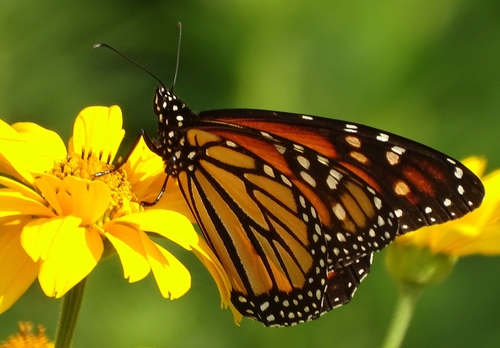
Monarch butterflies have a distinctive black, orange, and white wing pattern and a wingspan of about 9 to 10 cm. In North America they migrate each fall from the United States and Canada down to Florida and Mexico.
Source: Wikipedia
How to recognize it
Their wings show a recognizable black, orange, and white pattern.
Source: Wikipedia
Where it lives
People often keep monarchs in plastic or glass containers inside homes, such as kitchens or basements, with artificial light and controlled temperature.
Source: Wikipedia
Life cycle
Monarchs undergo complete metamorphosis: egg, larva, pupa, and adult. Development from egg to adult can be as quick as 25 days in warm summer weather, or up to seven weeks in cooler spring conditions.
Source: Wikipedia
When you see it
The eastern North American population migrates southward in late summer and autumn.
Source: Wikipedia
Where it comes from
They are native to the Americas, from southern Canada down to northern South America.
Source: Wikipedia
Lookalikes
The viceroy butterfly looks similar but is smaller and has an extra black stripe on each hindwing.
Source: Wikipedia
Where it is found in the US
Recorded in 51 of 51 states and DC. Most records: Kansas, Texas, California, Minnesota, Iowa, Illinois, Pennsylvania, New York.
Darker = more records. Counts are museum and citizen-science records, not population size.
Source: GBIF
Months it is reported in the US
Source: GBIF
More photos
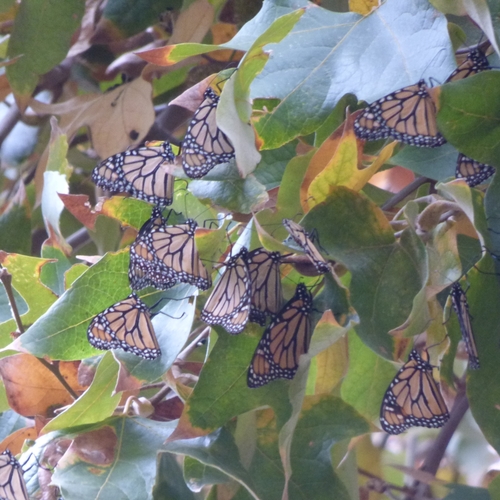
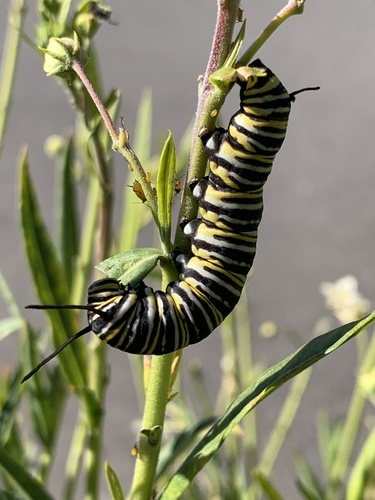

Same family (Nymphalidae)





Sources
- Wikipedia: https://en.wikipedia.org/wiki/Monarch_butterfly
Look it up elsewhere: GBIF · iNaturalist · BugGuide · ITIS · Wikipedia
Text written 2026-10-22 from the sources above and checked sentence by sentence against them. Data fetched 2026-10-22.