 Bug FAQ
Yellow Pansy
Junonia hierta · Order: Lepidoptera · Family: Nymphalidae

Male Yellow Pansy butterflies have bright yellow upper wings with distinctive black triangular markings and white streaks near the wing tip. They are found in open scrub and grassland areas across Africa and Southeast Asia.
Source: Wikipedia
How to recognize it
Males show bright yellow on the upper side of the wings. The forewing costa has a broad black triangle pointing down, and the dorsum has a black triangle pointing up near the tornus; the black margin narrows at the middle of the termen and has two short white streaks near the apex crossed by black veins. Females look similar but with duller colours, and both sexes have a pale subterminal line and a small, ill-defined blue spot on the hindwing.
Source: Wikipedia
What it eats
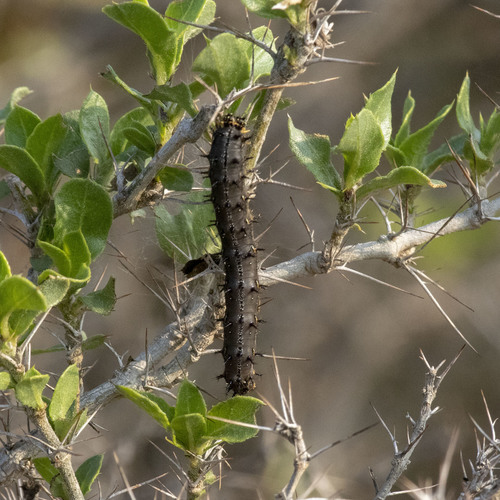
Caterpillars are dark brown or grey with a dorsal stripe of tiny white and blue spots and black spines.
Source: Wikipedia
Life cycle
The larva has a dark brown or grey ground colour with a broad dorsal stripe of minute white and blue spots and black spines. The pupa is dull reddish, with a blunt head, a convex thorax, and rows of small blackish points on the abdomen.
Source: Wikipedia
Where it comes from
The species occurs in Africa and Southeast Asia.
Source: Wikipedia
Lookalikes
Females are similar to males but with duller colours; both have a pale subterminal line and a small, ill-defined blue spot on the hindwing.
Source: Wikipedia
More photos


Same family (Nymphalidae)






Sources
- Wikipedia: https://en.wikipedia.org/wiki/Junonia_hierta
Look it up elsewhere: GBIF · iNaturalist · BugGuide · Wikipedia
Text written 2026-10-22 from the sources above and checked sentence by sentence against them. Data fetched 2026-10-22.