 Bug FAQ
Yellow-banded Polybia Wasp
Polybia occidentalis · Order: Hymenoptera · Family: Eumenidae
Source: Wikipedia

The yellow-banded Polybia wasp is black with a few yellow abdominal stripes and has thin wings attached to a long, thin petiole. It lives in tropical Neotropical forests from Mexico to northern Argentina, building nests in low areas such as trees, bushes, hedges, or buildings.
Source: Wikipedia
How to recognize it
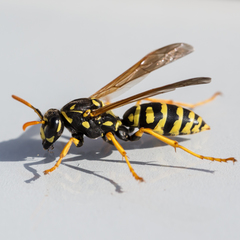
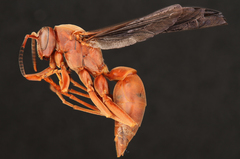
It is black with a few yellow stripes on its abdomen. Its wings are thin and the thorax connects to the abdomen with a long, thin petiole.
Source: Wikipedia
Size
The costal length of the wing ranges from about 3.6 to 4.7 mm. Workers weigh between roughly 3.8 and 6.7 mg when dry.
Source: Wikipedia
Does it bite or sting?
When threatened, workers fly rapidly toward an intruder and try to sting it.
Source: Wikipedia
Where it lives
It inhabits Neotropical tropical forests that have a strong wet-dry seasonality. Nests are built where resources for the wet season are available and can be used through the dry season.
Source: Wikipedia
What it eats
It feeds on insect prey such as caterpillars, as well as nectar and other carbohydrate sources.
Source: Wikipedia
Life cycle
Colonies last about a year, following an annual cycle. At the start of the dry season, workers and queens build nests and reproduce.
Source: Wikipedia
When you see it
During the wet season, males are produced first, followed by future queens.
Source: Wikipedia
Where it comes from
It is found from Mexico down to northern Argentina. It is common in Costa Rica and Brazil.
Source: Wikipedia
Questions people ask
Where do they build their nests?
They nest in low areas like trees, bushes, hedges, and sometimes buildings.
Source: Wikipedia
What do they eat?
They hunt insects such as caterpillars and also collect nectar and other sugary foods.
Source: Wikipedia
Same family (Eumenidae)


Sources
- Wikipedia: https://en.wikipedia.org/wiki/Polybia_occidentalis
Look it up elsewhere: GBIF · iNaturalist · BugGuide · Wikipedia
Text written 2026-10-23 from the sources above and checked sentence by sentence against them. Data fetched 2026-10-22.