 Bug FAQ
Northern Paper Wasp
Polistes fuscatus · Order: Hymenoptera · Family: Eumenidae
Also called: Common Paper Wasp, Dark Paper Wasp, Hypervariable Paper Wasp, Imposter Paper Wasp
Source: Wikipedia, cals.cornell.edu
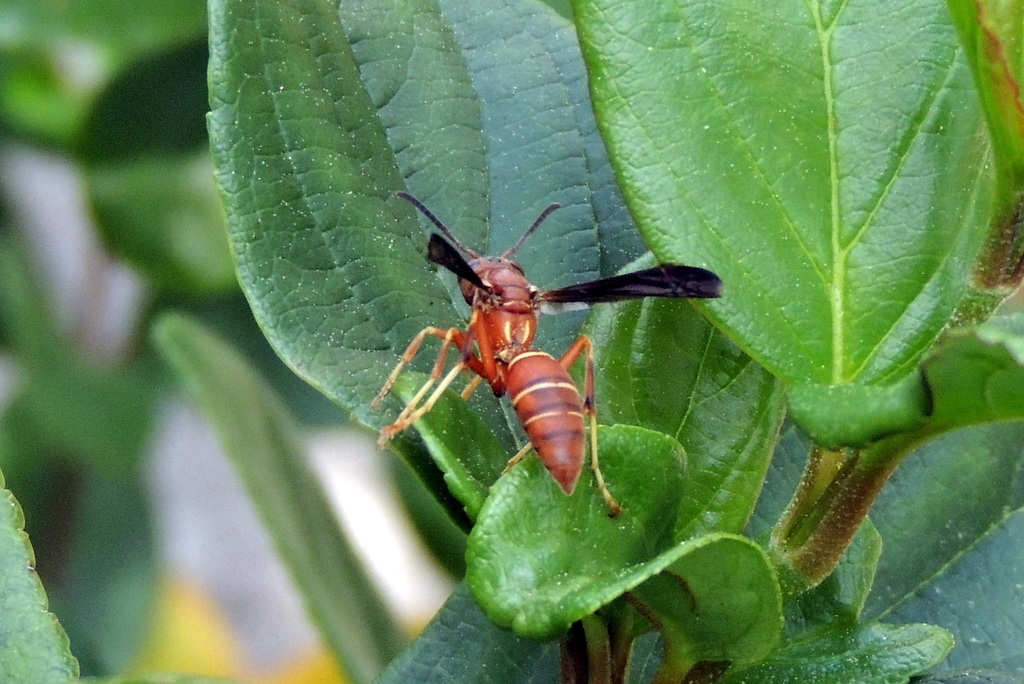
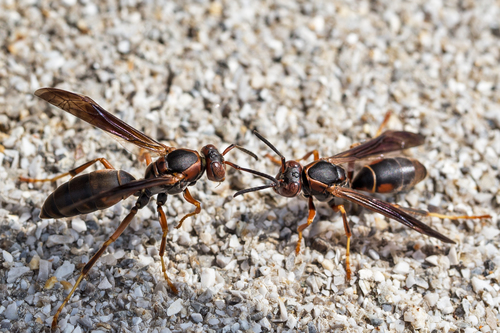
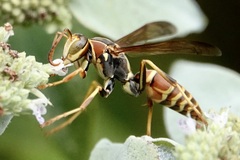
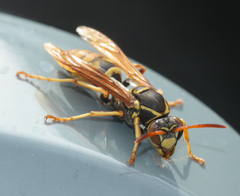
Northern paper wasps are 15-21 mm long, black with yellow stripes, and have a narrow waist and long legs. They build umbrella-shaped paper nests near human structures or wood, especially in early spring, and the colony lasts about a year. Females can sting when disturbed, causing a sharp, needle-like pain.
Source: Wikipedia, cals.cornell.edu, University of Minnesota Extension
How to recognize it
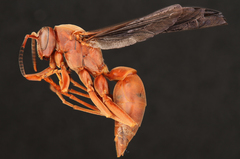
Males have darkened tips on their antennae, while females are entirely black-body with possible yellow markings. They are not fuzzy like bees, have a clear waist between thorax and abdomen, and long legs. Queens are 5/8-3/4 inches long, slender, mostly black with yellow stripes, and have a smooth, sparsely haired body.
Source: Wikipedia, cals.cornell.edu, University of Minnesota Extension
Size
Adults measure 15-21 mm (0.59-0.83 in) in length. Forewing length is 11.5-17 mm; males usually exceed 13 mm and females exceed 11 mm.
Source: Wikipedia
Does it bite or sting?
Females have a venomous sting that feels like a large needle prick, similar to a tattoo.
Source: Wikipedia
How to get rid of it
Integrated pest management helps reduce encounters with wasps while protecting the insects and people. Nests do not survive freezing temperatures and are not reused.
Where it lives
They often nest near human development but prefer areas with wood for nest material, such as woodlands and savannas. A mutated form is attracted to cold lamps like fluorescents and nests nearby.
Source: Wikipedia
What it eats
They are generalist foragers, taking a wide variety of prey.
Source: Wikipedia
Life cycle
The life cycle lasts about one year. In early spring a foundress emerges from diapause and builds an umbrella-shaped paper nest suspended from a single stalk.
Source: Wikipedia
When you see it
Mating occurs in spring and summer after the nest is abandoned. New colonies are started in early spring when the foundress emerges.
Source: Wikipedia
Lookalikes
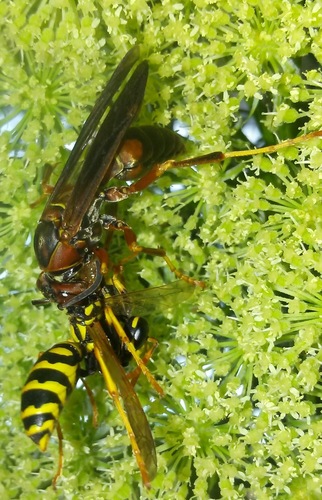
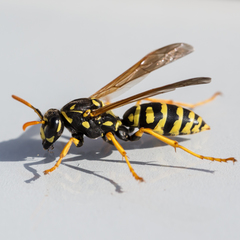
They can be confused with yellow jackets because of similar coloring, but yellow jackets have shorter legs and are more compact.
Source: cals.cornell.edu
Where it is found in the US
Recorded in 49 of 51 states and DC. Most records: New York, Illinois, Massachusetts, Minnesota, Ohio, Pennsylvania, Wisconsin, Michigan.
Darker = more records. Counts are museum and citizen-science records, not population size.
Source: GBIF
Status: native in North America; native in Canada; native in United States. Source: iNaturalist
Months it is reported in the US
Source: GBIF
More photos
Questions people ask
Do northern paper wasps sting people?
Yes, the female can sting when disturbed, causing a sharp, needle-like pain.
Source: Wikipedia, cals.cornell.edu
How can I prevent a nest near my house?
Remove wood debris, seal cracks, and use integrated pest management to make the area less attractive for nesting.
Source: Wikipedia, cals.cornell.edu
When are northern paper wasps most active?
They are active in spring and summer for mating and nest building, with new colonies starting in early spring.
Source: Wikipedia
What do northern paper wasps look like?
They are slender, black with yellow stripes, have a narrow waist, long legs, and lack the fuzz of bees.
Same family (Eumenidae)
Sources
- Wikipedia: https://en.wikipedia.org/wiki/Polistes_fuscatus
- cals.cornell.edu: https://cals.cornell.edu/new-york-state-integrated-pest-management/outreach-education/whats-bugging-you/bees-and-wasps/paper-wasps
- University of Minnesota Extension: https://apps.extension.umn.edu/garden/diagnose/insect/indoor/flies/large/paper-wasps.html
Look it up elsewhere: GBIF · iNaturalist · BugGuide · ITIS · Wikipedia
Text written 2026-10-23 from the sources above and checked sentence by sentence against them. Data fetched 2026-10-23.