 Bug FAQ
European Paper Wasp
Polistes dominula · Order: Hymenoptera · Family: Eumenidae
Also called: Paper Wasp
Source: UC IPM

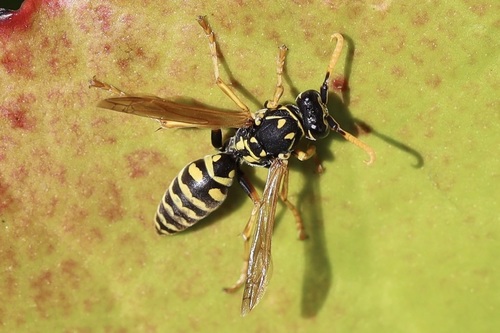
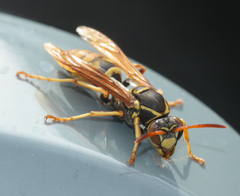
The European Paper Wasp is a slender, yellow-and-black wasp about an inch long with long legs and a narrow waist. It is an invasive species in North America, lives in cooler regions, and is not very aggressive, though its sting can be painful and cause allergies.
How to recognize it
Its body is entirely yellow and black, like the common German yellowjacket, and females have a black mark under the antennae that may have tiny yellow spots.
Source: Wikipedia
Size
Males have wings 9.5 to 13 mm long and females 8.5 to 12 mm.
Source: Wikipedia
Is it a pest in the house?
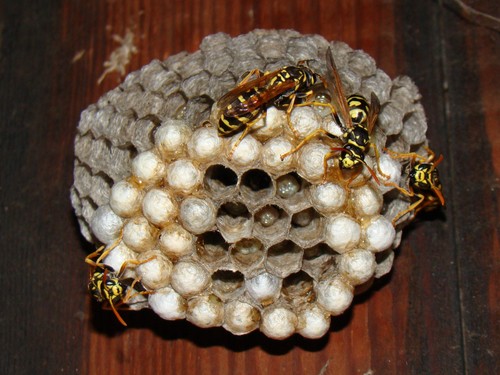
Paper wasps are not very defensive but can become a nuisance when they build nests over doorways or near fruit trees.
Source: UC IPM
Does it bite or sting?
Males cannot sting; workers and queens can sting, which usually hurts briefly but may cause severe allergic reactions in some people.
How to get rid of it
Knocking down new nests early in the season forces the founding female to relocate, and insecticide sprays labeled for wasps can be used carefully.
Source: UC IPM
Where it lives
It is considered invasive in Canada and the United States.
Source: Wikipedia
What it eats
It eats many kinds of insects, giving it better survival when food is scarce.
Source: Wikipedia
Life cycle
Males appear later in the season, and some daughters may mate and become future nest founders.
Source: Wikipedia
When you see it
Since the 1980s its range has moved into cooler, northern European areas.
Source: Wikipedia
Where it comes from
It originates from southern Europe, North Africa, and temperate Asia as far east as China.
Source: Wikipedia
Lookalikes
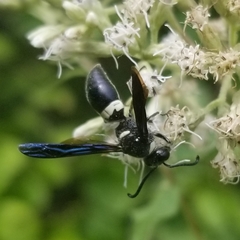
It looks like the German yellowjacket, while mud daubers are dark and thread-waisted, and honey bees are less brightly striped and hairier.
Where it is found in the US
Recorded in 50 of 51 states and DC. Most records: California, New York, Colorado, Washington, Oregon, Utah, Ohio, Illinois.
Darker = more records. Counts are museum and citizen-science records, not population size.
Source: GBIF
Status: introduced in North America; introduced in United States; introduced in Canada. Source: iNaturalist
Months it is reported in the US
Source: GBIF
More photos
Questions people ask
Do European Paper Wasps sting?
Only the females can sting; they are not aggressive and usually only sting if provoked, causing pain and possible allergic reactions.
Are they a problem in homes?
They are not highly defensive, but nests built over doorways or near fruit trees can be a nuisance.
Source: UC IPM
How can I get rid of a nest?
Remove new nests early in the season or use a labeled wasp insecticide with caution.
Source: UC IPM
Same family (Eumenidae)

Sources
- UC IPM: https://ipm.ucanr.edu/PMG/PESTNOTES/pn7450.html
- Wikipedia: https://en.wikipedia.org/wiki/European_paper_wasp
Look it up elsewhere: GBIF · iNaturalist · BugGuide · Wikipedia
Text written 2026-10-22 from the sources above and checked sentence by sentence against them. Data fetched 2026-10-22.