 Bug FAQ
Yellow-banded Pansy
Junonia elgiva · Order: Lepidoptera · Family: Nymphalidae
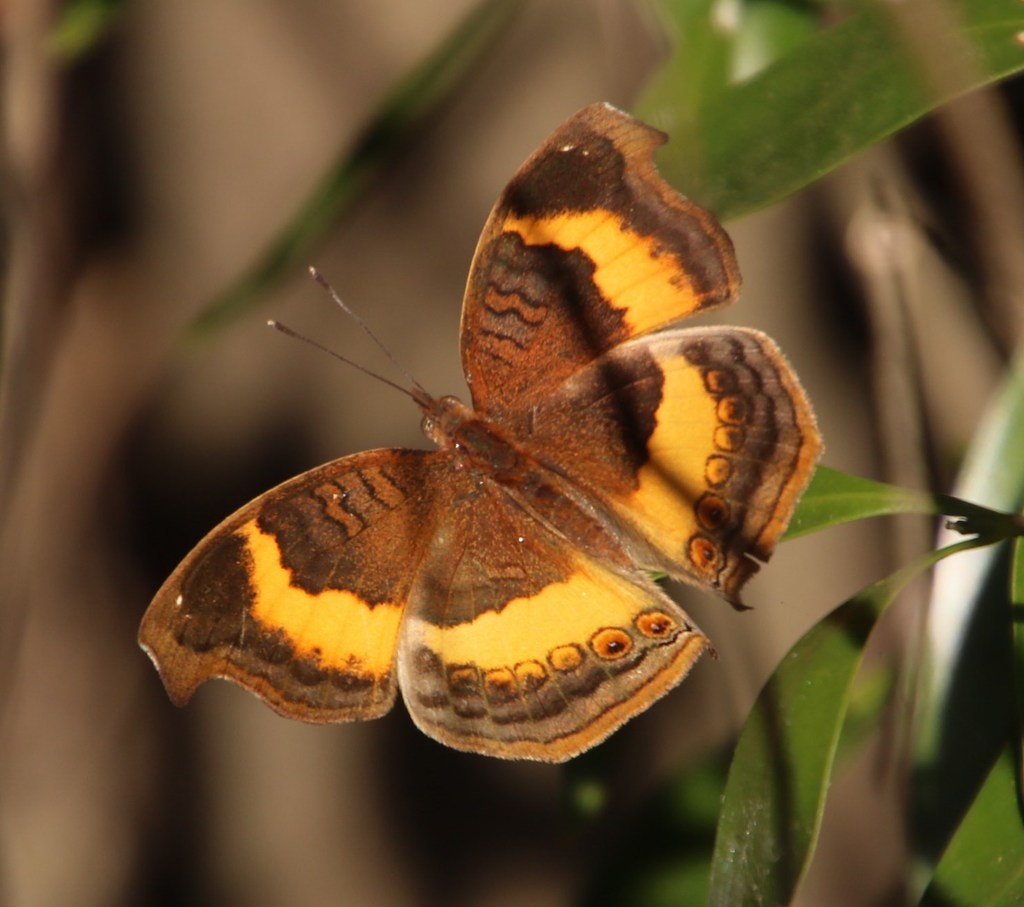
Yellow-banded pansies are medium to large butterflies with a wingspan of about 40 to 110 mm and a brown or grey ground colour tinged with blue, marked with orange, blue or pink spots. Their caterpillars eat a wide range of plants, including members of the mint, acanthus, amaranth, figwort, evening primrose, legume, balsam, grass, melastome, plantain, and daisy families. The larvae are stout and spiny, and the pupae have raised tubercles and a slightly bifid head.
Source: Wikipedia
How to recognize it
The butterfly’s wings are brown or grey with a blue tint and display orange, blue or pink spots, sometimes large.
Source: Wikipedia
Size
Adults have a wingspan ranging from 40 to 110 mm, classifying them as medium to large butterflies.
Source: Wikipedia
Life cycle
Larvae are stout, uniformly thick, and bear strong branched spines, sometimes with two short head spines; pupae are moderately angulated with raised back tubercles and a slightly bifid head.
Source: Wikipedia
When you see it
In South India, the species tends to show very sensitive behaviour.
Source: Wikipedia
Where it comes from
Members of the genus Junonia are found on every continent except Antarctica and Europe.
Source: Wikipedia
Lookalikes
Junonia butterflies are commonly called buckeyes, pansies, or commodores.
Source: Wikipedia
More photos


Same family (Nymphalidae)






Sources
- Wikipedia: https://en.wikipedia.org/wiki/Junonia
Look it up elsewhere: GBIF · iNaturalist · BugGuide · ITIS · Wikipedia
Text written 2026-10-23 from the sources above and checked sentence by sentence against them. Data fetched 2026-10-22.