 Bug FAQ
Xylocopa augusti
Xylocopa augusti · Order: Hymenoptera · Family: Apidae
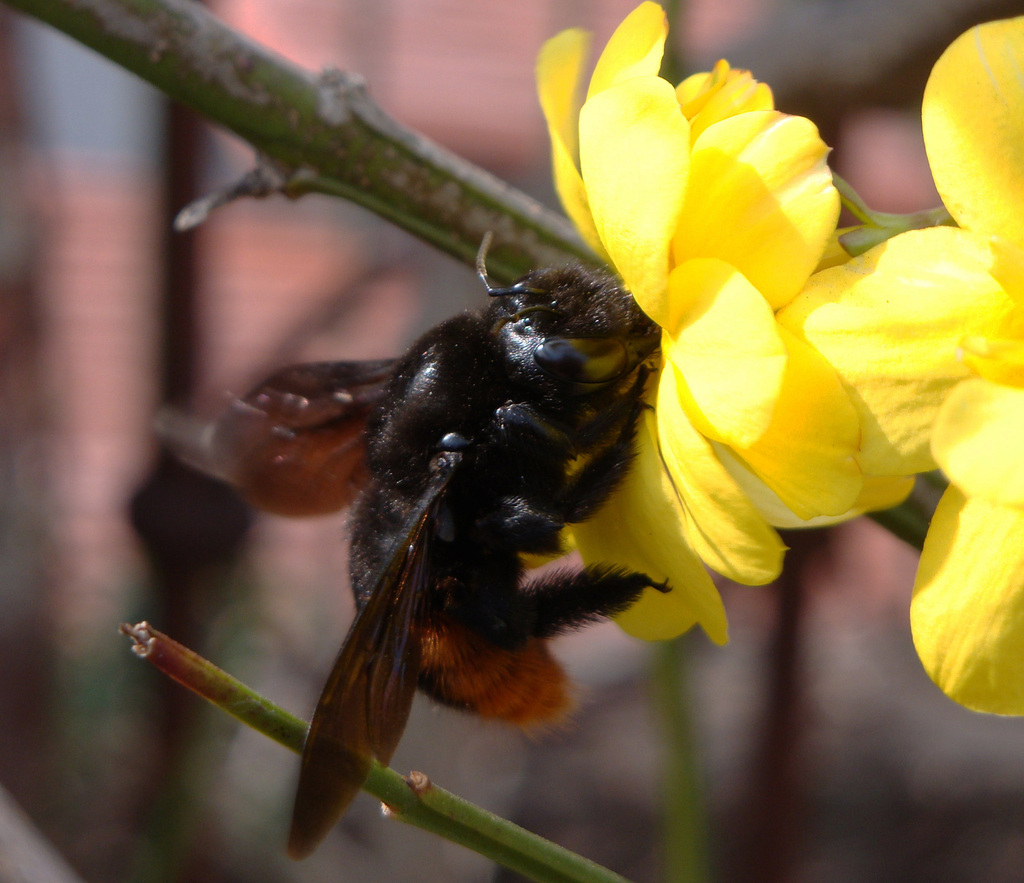
The bee is large, about 25 to 30 mm long, with a black body and reddish side hairs, and dark brown wings that show a violet shine. It nests in wood or tree trunks and is found from December through March in Argentina, Chile, Brazil, Paraguay and Uruguay. Adults visit many flowers, including Passiflora, Agapanthus, Alstroemeria, Cleome, Parkinsonia, Quillaja, Robinia, Solanum, Styphnolobium, Eucalyptus and Amaryllis.
Source: Wikipedia
How to recognize it
It has a black body with noticeable reddish side hairs and dark brown wings that reflect violet.
Source: Wikipedia
Size
It grows to about 25 to 30 mm (1 in) in length.
Source: Wikipedia
Where it lives
It makes its nests in wood and tree trunks.
Source: Wikipedia
What it eats
It visits flowers of many plants such as Passiflora, Agapanthus, Alstroemeria, Cleome, Parkinsonia, Quillaja, Robinia, Solanum, Styphnolobium, Eucalyptus and Amaryllis.
Source: Wikipedia
Life cycle
Adults can be seen from December to March.
Source: Wikipedia
When you see it
They are active from December through March.
Source: Wikipedia
Where it comes from
It occurs in Argentina, Chile, Brazil, Paraguay and Uruguay.
Source: Wikipedia
Lookalikes
It is a species of carpenter bee.
Source: Wikipedia
More photos
Same family (Apidae)





Sources
- Wikipedia: https://en.wikipedia.org/wiki/Xylocopa_augusti
Look it up elsewhere: GBIF · iNaturalist · BugGuide · ITIS · Wikipedia
Text written 2026-10-23 from the sources above and checked sentence by sentence against them. Data fetched 2026-10-22.