 Bug FAQ
Eastern Carpenter Bee
Xylocopa virginica · Order: Hymenoptera · Family: Apidae
Also called: Carpenter Bee, Virginia Carpenter Bee
Source: Wikipedia, Penn State Extension

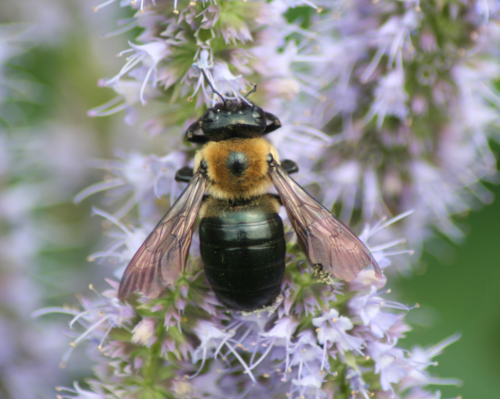
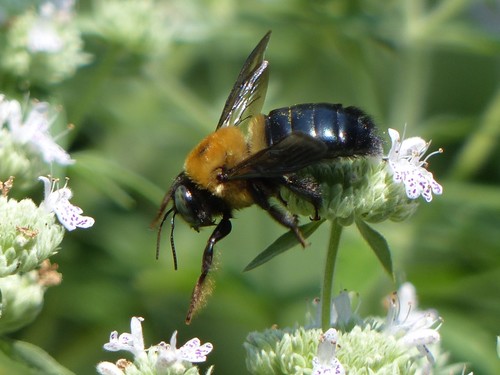
These bees look like large bumblebees but have a shiny, hair-less black abdomen and bright hairs on the thorax. They drill perfectly round holes about half an inch wide in unpainted wood such as doors, eaves, or furniture, and the fine sawdust they leave can be seen below the holes.
Source: entomology.ca.uky.edu, hgic.clemson.edu, Penn State Extension
How to recognize it
Adults are glossy black with a metallic purple tint and the top of the abdomen is hairless and shiny. Males have a white spot on the face and white markings on the head.
Source: Wikipedia, Penn State Extension, hgic.clemson.edu
Size
They are about the size of a bumblebee.
Source: Wikipedia
Is it a pest in the house?
They do not eat wood but excavate tunnels, which can cause cosmetic and structural damage to wooden structures. They prefer unpainted, weathered soft woods such as redwood, cedar, cypress and pine. Fine sawdust from their tunneling is often found on the ground beneath the entrance holes.
Source: Penn State Extension, entomology.ca.uky.edu, hgic.clemson.edu
Does it bite or sting?
Males lack a stinger and cannot sting. Females have a stinger and will sting only if they are roughly handled or provoked.
Source: Wikipedia, Penn State Extension, hgic.clemson.edu, entomology.ca.uky.edu
How to get rid of it
Locate the active holes and apply insecticide dust, liquid, or aerosol directly into the openings before the tunnels are fully built. Painting wood with oil-based or polyurethane paint is the most effective way to deter them. Because treating eaves and soffits can be risky, many homeowners hire a licensed pest-control professional.
Source: Penn State Extension, entomology.ca.uky.edu, hgic.clemson.edu
Where it lives
They nest in wood, bamboo, agave stalks and especially in milled pine or cedar lumber. Because they build nests in wood, they are often found in furniture, doors, windowsills and other building components.
Source: Wikipedia
What it eats
Adults feed on nectar and pollen. Newly emerged bees may be given nectar but they do not have stored food in the nest.
Source: Wikipedia
Life cycle
Mating happens once each spring. Eggs are laid in July deep in the tunnel; by late summer the larvae have pupated and become adults.
Source: Wikipedia
When you see it
New adults emerge with soft cuticles and white wings that darken over a few days; they can fly after 3 to 4 days but stay in the nest for at least two weeks.
Source: Wikipedia
Lookalikes
They are often mistaken for bumblebees because of similar size, but bumblebees have a fully hairy abdomen. They share range with the smaller Xylocopa micans in the southeastern United States.
Source: Penn State Extension, entomology.ca.uky.edu, Wikipedia
Where it is found in the US
Recorded in 43 of 51 states and DC. Most records: Texas, North Carolina, Ohio, Virginia, New York, Pennsylvania, Maryland, Georgia.
Darker = more records. Counts are museum and citizen-science records, not population size.
Source: GBIF
Months it is reported in the US
Source: GBIF
More photos

Questions people ask
How can I tell an Eastern carpenter bee from a bumblebee?
Carpenter bees have a shiny, hairless black abdomen and bright thoracic hairs, while bumblebees have a fully hairy abdomen.
Do carpenter bees damage my house?
They excavate round holes in unpainted wood, which can cause cosmetic and structural damage over time.
Source: Penn State Extension, entomology.ca.uky.edu, hgic.clemson.edu
Can carpenter bees sting me?
Only the female can sting, and she usually does so only if she is handled or provoked.
Source: Wikipedia, Penn State Extension, entomology.ca.uky.edu
What is the best way to keep carpenter bees away?
Paint exposed wood surfaces with oil-based or polyurethane paint, and treat any active holes with an appropriate insecticide.
Source: hgic.clemson.edu, Penn State Extension
Same family (Apidae)

Sources
- Wikipedia: https://en.wikipedia.org/wiki/Eastern_carpenter_bee
- Penn State Extension: https://extension.psu.edu/carpenter-bees
- entomology.ca.uky.edu: https://entomology.ca.uky.edu/ef611
- hgic.clemson.edu: https://hgic.clemson.edu/factsheet/carpenter-bees/
Look it up elsewhere: GBIF · iNaturalist · BugGuide · ITIS · Wikipedia
Text written 2026-10-23 from the sources above and checked sentence by sentence against them. Data fetched 2026-10-23.