 Bug FAQ
Ambrosia beetle (Xyleborus affinis)
Xyleborus affinis · Order: Coleoptera · Family: Curculionidae
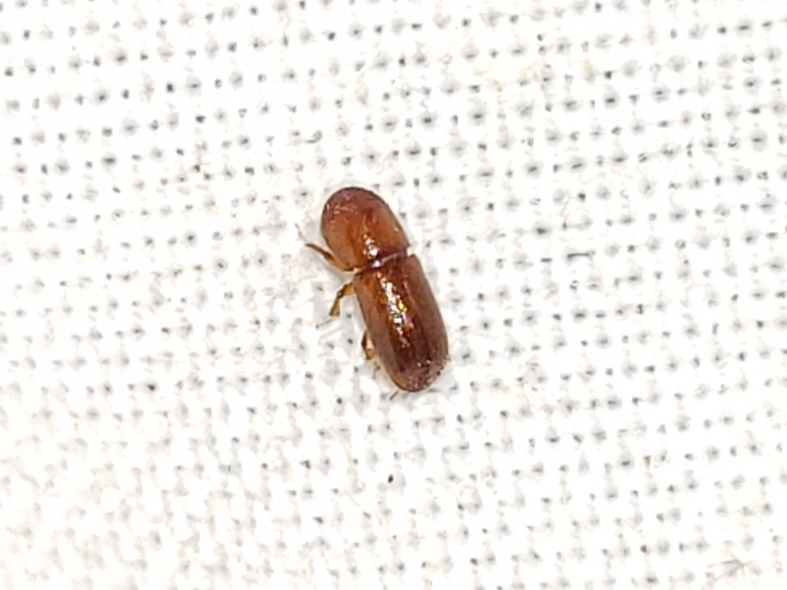
Xyleborus affinis is a small beetle about 2 mm long, with females a bit larger than males. It lives in damp, decaying logs in woodlands, especially those partially submerged or on moist ground. Females lay eggs in galleries lined with a symbiotic fungus, and the larvae feed exclusively on that fungus.
Source: Wikipedia
How to recognize it
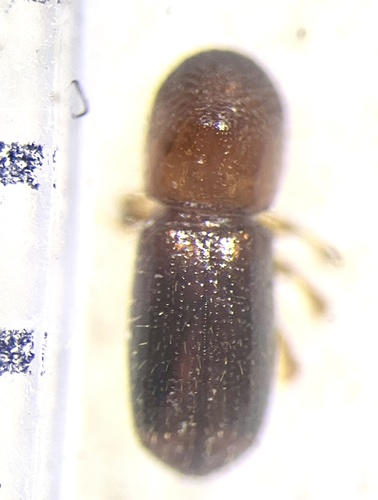
The beetle is yellow-brown, cylindrical, and its abdomen slopes downward at the end of the wing covers, with a dull, non-shiny surface.
Source: Wikipedia
Size
Females measure roughly 2.0 to 2.7 mm, while males are a bit smaller at 1.7 to 2.0 mm.
Source: Wikipedia
Where it lives
It prefers natural woodlands and is most often found on damp logs lying on the ground. The beetle is attracted to freshly fallen, early-decay logs.
Source: Wikipedia
What it eats
Females deposit eggs in fungus-lined tunnels, and both eggs and larvae rely on that fungus for nutrition.
Source: Wikipedia
Life cycle
The species reproduces via haplodiploidy, a sex-determination system common to its genus. At about 29 °C, females can start laying eggs between three and 27 days after entering a suitable log.
Source: Wikipedia
Where it comes from
Xyleborus affinis originates from the tropical Americas and is common in warm U.S. states such as Florida.
Source: Wikipedia
Lookalikes
It closely resembles Xyleborus perforans and Xyleborus volvulus, but can be told apart by the dull, non-transparent declivity of its abdomen.
Source: Wikipedia
Where it is found in the US
Recorded in 11 of 51 states and DC. Most records: Florida, Texas, Kansas, Indiana, Tennessee, Delaware, Louisiana, Virginia.
Darker = more records. Counts are museum and citizen-science records, not population size.
Source: GBIF
Status: native in North America; native in Canada. Source: iNaturalist
Months it is reported in the US
Source: GBIF
More photos
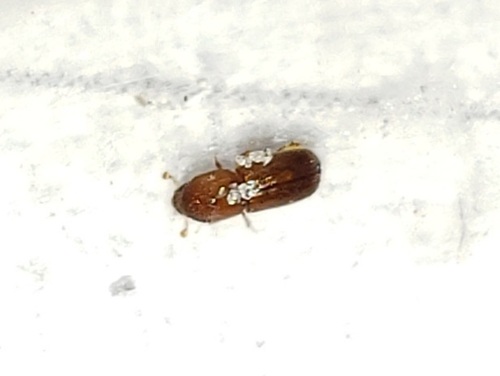
Questions people ask
How can I identify Xyleborus affinis?
Look for a yellow-brown, elongated beetle whose abdomen slopes down at the wing-cover tip and has a dull, non-shiny surface.
Source: Wikipedia
Where does Xyleborus affinis live?
It is native to the tropical Americas and is common in the eastern United States, from Michigan down to Florida and west to Texas.
Source: Wikipedia
What do the larvae eat?
The larvae feed solely on the symbiotic fungus that lines the galleries where the eggs are laid.
Source: Wikipedia
What other beetles look similar?
Xyleborus perforans and Xyleborus volvulus look alike, but X. affinis has a dull, non-transparent declivity on its abdomen.
Source: Wikipedia
Same family (Curculionidae)
 Green Immigrant Leaf WeevilPolydrusus formosusDamages trees, gardens or crops
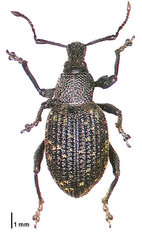 Black Vine WeevilOtiorhynchus sulcatusDamages trees, gardens or crops
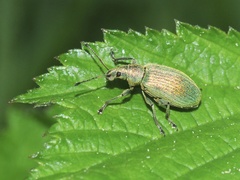 Nettle weevilPhyllobius pomaceusDamages trees, gardens or crops
 Asian Oak WeevilCyrtepistomus castaneusDamages trees, gardens or crops
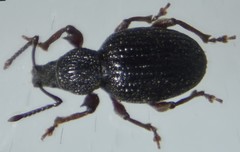 Strawberry Root WeevilOtiorhynchus ovatusDamages trees, gardens or crops
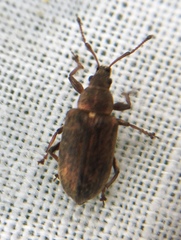 Common Leaf WeevilPhyllobius pyriDamages trees, gardens or crops
Sources
- Wikipedia: https://en.wikipedia.org/wiki/Xyleborus_affinis
Look it up elsewhere: GBIF · iNaturalist · BugGuide · ITIS · Wikipedia
Text written 2026-10-25 from the sources above and checked sentence by sentence against them. Data fetched 2026-10-25.