 Bug FAQ
Green Immigrant Leaf Weevil
Polydrusus formosus · Order: Coleoptera · Family: Curculionidae
Also called: Weevil
Source: Wikipedia
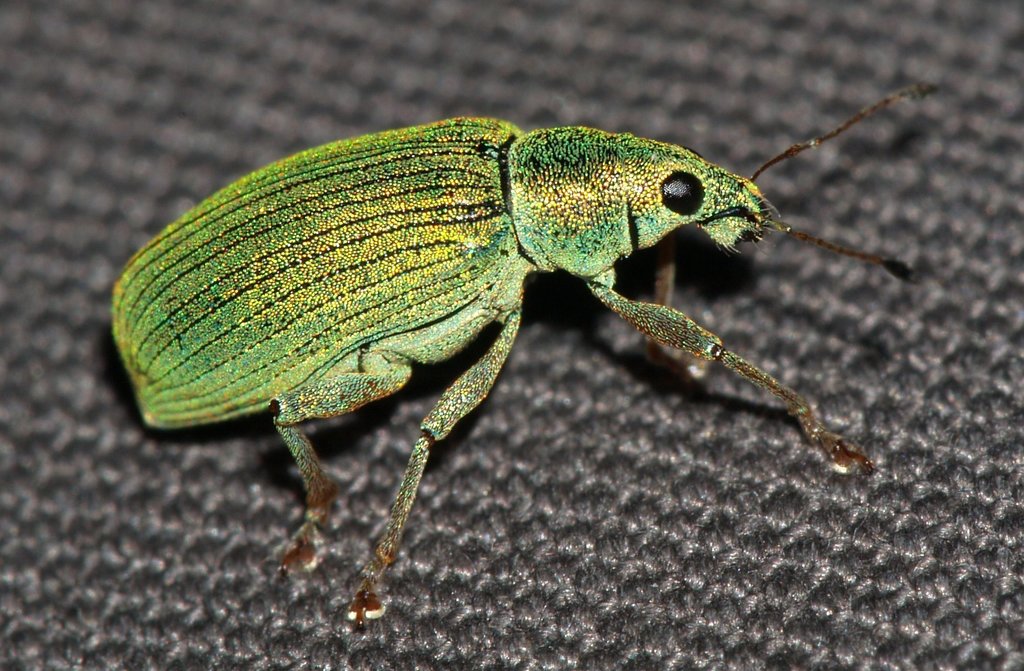
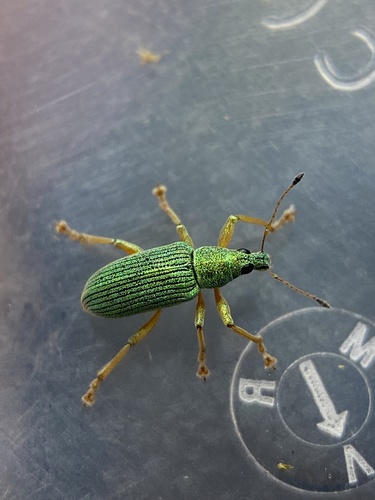
The green immigrant leaf weevil is a small beetle about 5 to 6 mm long as an adult and up to 7 mm as a larva. Adults are bright metallic green with pale antennae ending in a dark club, and they have a short groove between the eyes and distinct striae on the wing covers. They are found across most of Europe and the Nearctic region, live on a variety of woodland and fruit trees, and are most active from April to August.
Source: Wikipedia
How to recognize it
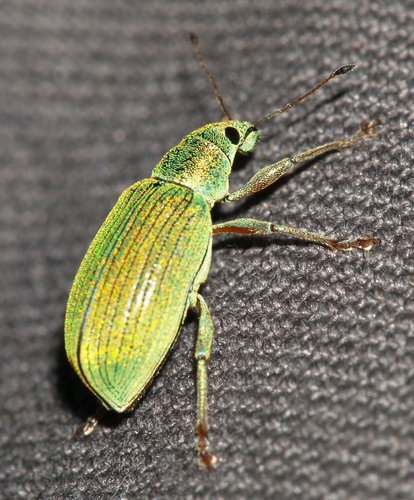
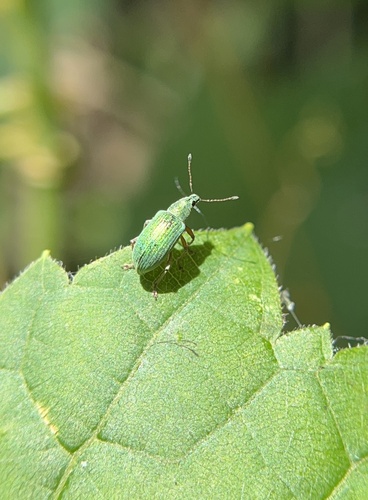
The beetle shines metallic green because its black body is covered with emerald-colored scales. Its antennae are pale with a dark club, it has a short groove between the eyes, and the elytra show clear striae.
Source: Wikipedia
Size
Adults grow to about 5 to 6 mm (0.20 to 0.24 in) long. Larvae in the soil can reach up to 7 mm (0.28 in) long.
Source: Wikipedia
Where it lives
They overwinter and pupate in the spring.
Source: Wikipedia
What it eats
Adults feed on young leaves and open flowers of many woodland trees, shrubs and fruit trees such as hazel, oak, apple, pear and cherry. Larvae live in the soil and eat juicy plant roots.
Source: Wikipedia
Life cycle
Adults are mainly seen from April through August. They spend the winter as adults and develop into pupae in spring.
Source: Wikipedia
When you see it
The beetles are most common in the warm months, April to August.
Source: Wikipedia
Where it comes from
The species occurs throughout most of Europe and also in the Nearctic realm.
Source: Wikipedia
Where it is found in the US
Recorded in 24 of 51 states and DC. Most records: Michigan, Minnesota, Wisconsin, Massachusetts, Illinois, New York, Maine, Vermont.
Darker = more records. Counts are museum and citizen-science records, not population size.
Source: GBIF
Status: introduced in Canada; introduced in United States. Source: iNaturalist
Months it is reported in the US
Source: GBIF
More photos
Questions people ask
What damage do they cause to my garden?
Adults eat young leaves and flowers of many trees and shrubs, and larvae feed on plant roots, which can harm fruit trees and other garden plants.
Source: Wikipedia
Same family (Curculionidae)
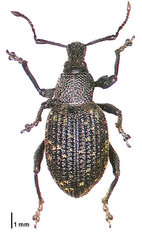 Black Vine WeevilOtiorhynchus sulcatusDamages trees, gardens or crops
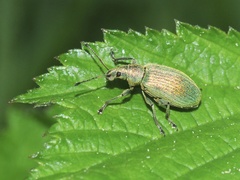 Nettle weevilPhyllobius pomaceusDamages trees, gardens or crops
 Asian Oak WeevilCyrtepistomus castaneusDamages trees, gardens or crops
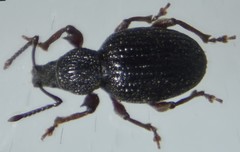 Strawberry Root WeevilOtiorhynchus ovatusDamages trees, gardens or crops
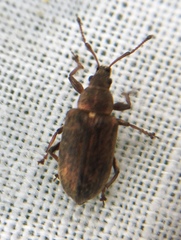 Common Leaf WeevilPhyllobius pyriDamages trees, gardens or crops
 Large Pine WeevilHylobius abietisDamages trees, gardens or crops
Sources
- Wikipedia: https://en.wikipedia.org/wiki/Polydrusus_formosus
Look it up elsewhere: GBIF · iNaturalist · BugGuide · Wikipedia
Text written 2026-10-22 from the sources above and checked sentence by sentence against them. Data fetched 2026-10-22.