 Bug FAQ
Xami Hairstreak
Xamia xami · Order: Lepidoptera · Family: Lycaenidae

The Xami hairstreak is a small tailed butterfly with a wingspan of about 2.4 to 2.9 cm. It lives in sunny, shaded spots on mountain and canyon slopes within coniferous woodlands of the southern United States, central Texas, Mexico and Guatemala. Its larvae feed on succulents such as Echeveria and Sedum, and adults lay eggs that hatch in roughly a week.
Source: Wikipedia
How to recognize it
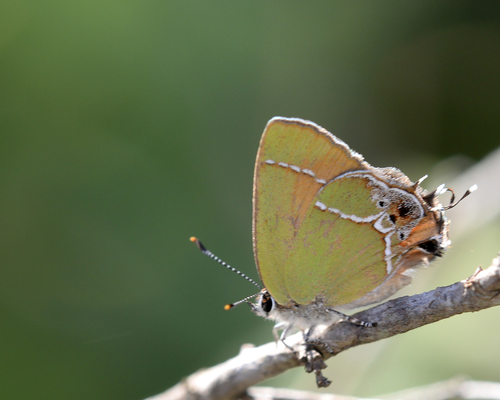
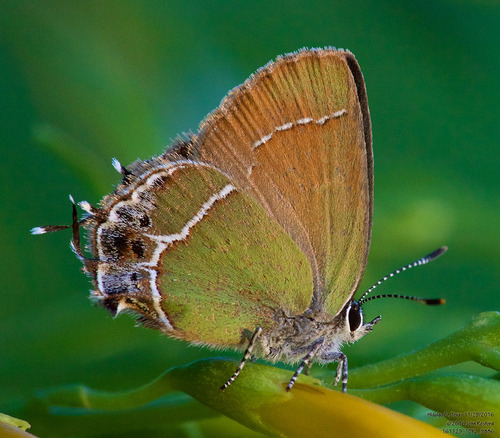
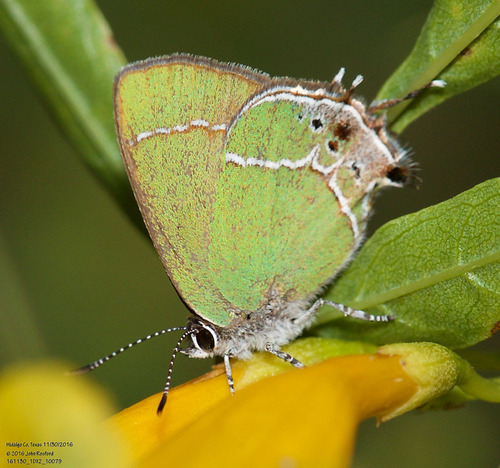
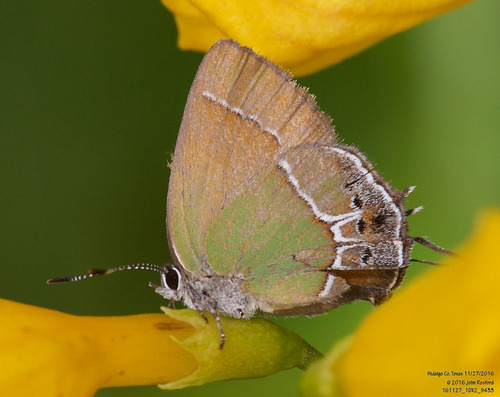
The underside of the hindwing is yellow-green with a post-median white line that forms a W-shaped mark toward the tails. Unlike the juniper hairstreak, it has a sharp W-shaped mark, and unlike the silver-banded hairstreak, its white line is not broad.
Source: Wikipedia
Size
Its wingspan ranges from 2.38 cm to 2.86 cm.
Source: Wikipedia
Where it lives
It prefers sunny areas that offer shade on mountain and canyon slopes near coniferous forests. It thrives in cool to warm temperate climates.
Source: Wikipedia
What it eats
Larvae feed on plants in the genera Echeveria and Sedum, which are succulents in the Crassulaceae family.
Source: Wikipedia
Life cycle
Eggs take about seven days to hatch. The caterpillar goes through at least three instars, possibly up to five.
Source: Wikipedia
When you see it
It has two or more flight periods each year, typically from March to December. Main flight times are in June and from September through December.
Source: Wikipedia
Where it comes from
It is native to the southern United States, especially southern and southeastern Arizona and central Texas. Its range extends south into Mexico and Guatemala, covering parts of North and Central America.
Source: Wikipedia
Lookalikes
Its eggs look similar to those of the juniper and silver-banded hairstreaks.
Source: Wikipedia
Where it is found in the US
Recorded in 2 of 51 states and DC. Most records: Arizona, Texas.
Darker = more records. Counts are museum and citizen-science records, not population size.
Source: GBIF
Months it is reported in the US
Source: GBIF
More photos
Questions people ask
What does the Xami hairstreak look like on the underside of its hindwing?
It is yellow-green with a white post-median line that makes a W-shaped mark toward the tails.
Source: Wikipedia
When can I see Xami hairstreaks flying?
They are active in June and again from September through December, with possible flights from March to December.
Source: Wikipedia
What plants do the caterpillars eat?
The larvae feed on succulents such as Echeveria and Sedum.
Source: Wikipedia
Same family (Lycaenidae)






Sources
- Wikipedia: https://en.wikipedia.org/wiki/Callophrys_xami
Look it up elsewhere: GBIF · iNaturalist · BugGuide · ITIS · Wikipedia
Text written 2026-10-28 from the sources above and checked sentence by sentence against them. Data fetched 2026-10-28.