 Bug FAQ
Common Blue
Polyommatus icarus · Order: Lepidoptera · Family: Lycaenidae
Also called: Mother-of-Pearl Blue, Common Blue Butterfly
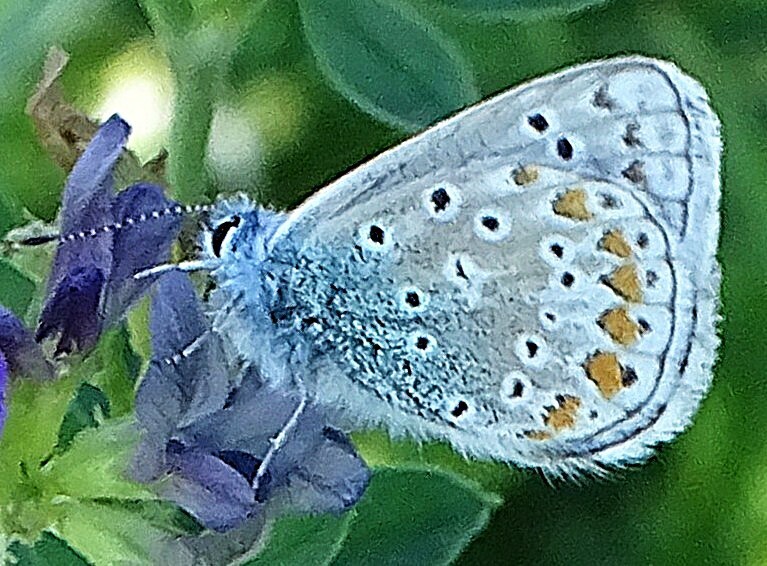
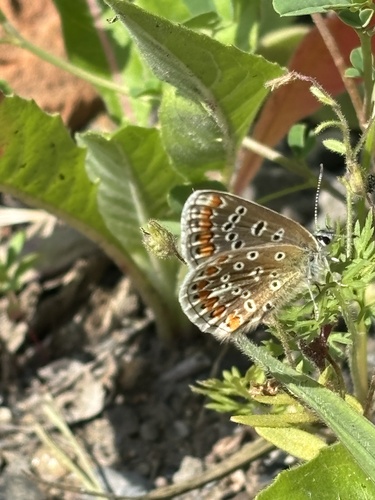
The Common Blue has a wingspan of about 28 to 36 mm and the males show a bright violet-blue dorsal wing surface with a thin black edge, while females are brown with red-yellow marginal spots and some blue near the base.
Source: Wikipedia
How to recognize it
Males have an iridescent lilac-blue dorsal wing surface with a thin black border; females are brown with a row of red-yellow spots along the wing edges and often a bit of blue at the base.
Source: Wikipedia
Size
Wingspan ranges from 28 to 36 mm (about 1.1 to 1.4 inches).
Source: Wikipedia
Where it lives
Found in flowery or grassy places, both warm and cool, open or wooded, from sea level up to high alpine meadows (0 to 2,700 m). Prefers chalk or limestone grassland but also occurs in woodland clearings, meadows, heathlands, sand dunes, railway embankments and under cliffs.
Source: Wikipedia
What it eats
Caterpillars feed on leaves. Adults drink nectar from wildflowers and also feed on excrement.
Source: Wikipedia
Life cycle
An adult lives about three weeks.
Source: Wikipedia
When you see it
In southern Britain there are two generations per year, flying in May-June and again in August-September; in northern England there is one generation flying from June to September.
Source: Wikipedia
Where it comes from
Native to Europe, North Africa, the Canary Islands and across the Palearctic to northern China. Has been introduced to North America.
Source: Wikipedia
Lookalikes
Similar species include Polyommatus semiargus, P. coridon, P. dorylas, P. amandus, P. damon and P. celina (-).
Source: Wikipedia
Where it is found in the US
Recorded in 3 of 51 states and DC. Most records: Vermont, New York, Colorado.
Darker = more records. Counts are museum and citizen-science records, not population size.
Source: GBIF
Status: introduced in Canada; introduced in United States. Source: iNaturalist
Months it is reported in the US
Source: GBIF
More photos
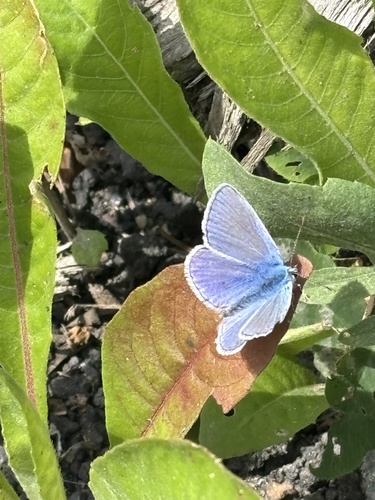
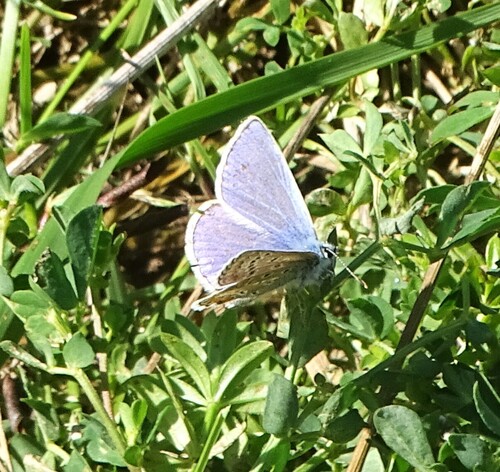
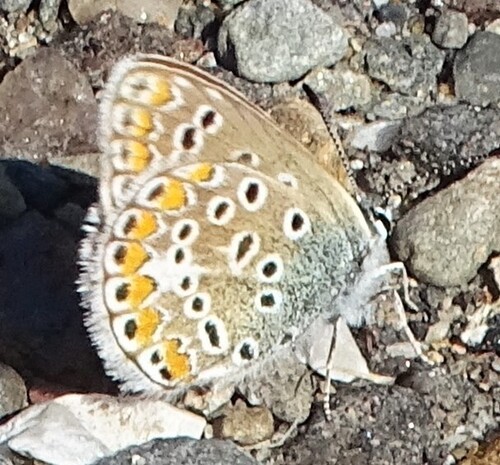
Same family (Lycaenidae)


Sources
- Wikipedia: https://en.wikipedia.org/wiki/Common_blue
Look it up elsewhere: GBIF · iNaturalist · BugGuide · Wikipedia
Text written 2026-10-22 from the sources above and checked sentence by sentence against them. Data fetched 2026-10-22.