 Bug FAQ
Gray Hairstreak
Strymon melinus · Order: Lepidoptera · Family: Lycaenidae
Also called: Grey Hairstreak, Cotton Square Borer
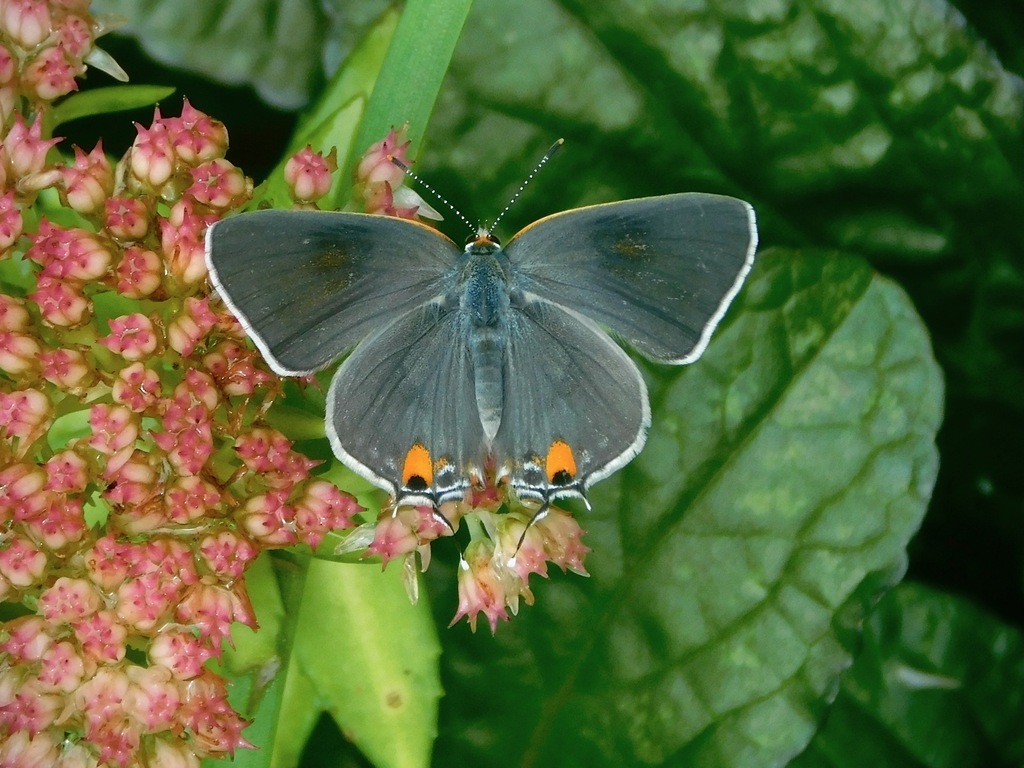
The gray hairstreak has a wingspan of about 20 to 32 mm (0.79 to 1.26 in). It lives in many habitats, from tropical forests and mountains to temperate woodlands, meadows, cities and farmland.
Source: Wikipedia
How to recognize it
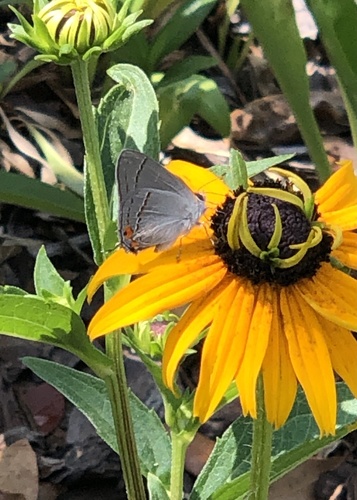
The upper side of each wing is gray with an orange spot near the hind margin.
Source: Wikipedia
Size
Adults measure 20 to 32 mm across the wings.
Source: Wikipedia
Where it lives
They are found in tropical forests, mountains, temperate woodlands, meadows, cities and farmland.
Source: Wikipedia
What it eats
Caterpillars eat a wide variety of plants, especially clovers such as rabbit-foot clover, white clover, bush clover, white sweet-clover and Malva neglecta.
Source: Wikipedia
Life cycle
The caterpillars are green with side markings and short yellow hairs. They are tended by ants, a behavior known as myrmecophily.
Source: Wikipedia
Where it comes from
The species is common across most of North America. It also occurs throughout Central America and the northern part of South America.
Source: Wikipedia
Where it is found in the US
Recorded in 49 of 51 states and DC. Most records: Texas, California, Arizona, Florida, Virginia, Maryland, North Carolina, Oregon.
Darker = more records. Counts are museum and citizen-science records, not population size.
Source: GBIF
Status: native in North America; native in Canada; native in United States. Source: iNaturalist
Months it is reported in the US
Source: GBIF
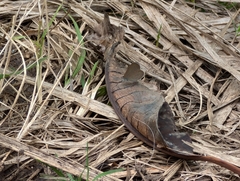
More photos
Same family (Lycaenidae)


Sources
- Wikipedia: https://en.wikipedia.org/wiki/Gray_hairstreak
Look it up elsewhere: GBIF · iNaturalist · BugGuide · ITIS · Wikipedia
Text written 2026-10-22 from the sources above and checked sentence by sentence against them. Data fetched 2026-10-22.