 Bug FAQ
Willow Flower Miner Bee
Andrena salicifloris · Order: Hymenoptera · Family: Andrenidae
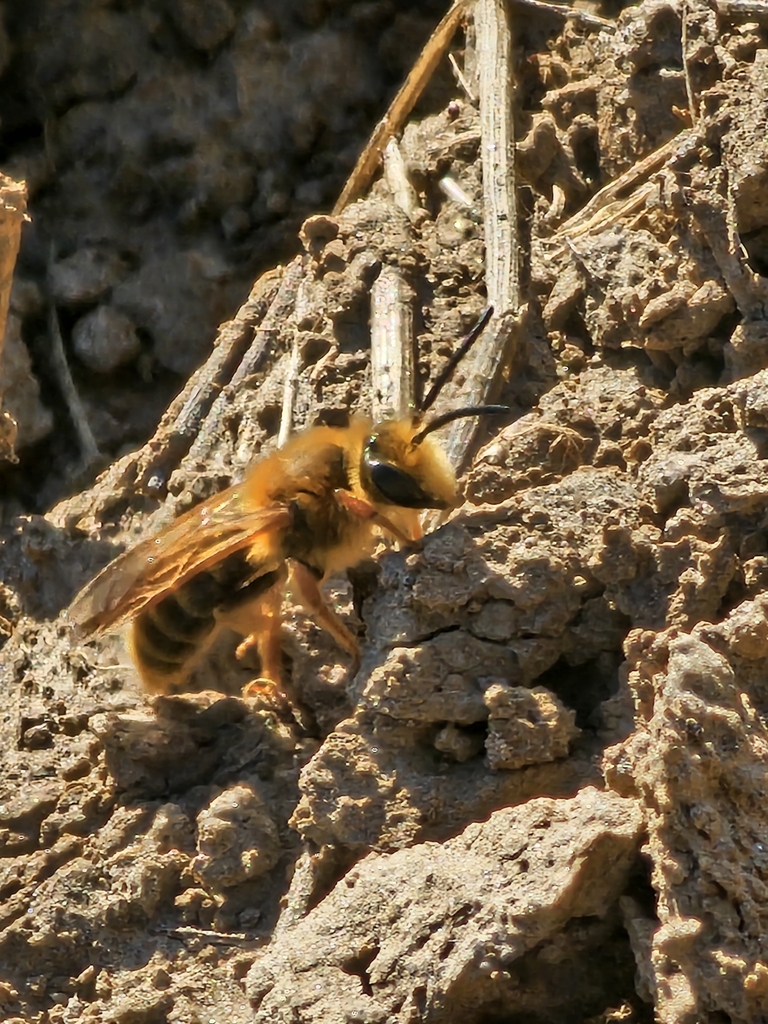
The willow flower miner bee is dark brown or black with sparse grayish hair on its thorax, legs and abdomen, and its wings are smoky with black veins. A mated female excavates a small tunnel that branches into side tunnels for nesting, and the larvae grow quickly but only emerge as adults in spring.
Source: Wikipedia
How to recognize it
The bee is dark brown or black with sparse grayish hair on its thorax, legs and abdomen, and its wings are smoky with black veins.
Source: Wikipedia
Where it lives
It inhabits arid and alpine lands across its range.
Source: Wikipedia
What it eats
Adults feed on nectar, while larvae consume both nectar and pollen.
Source: Wikipedia
Life cycle
A mated female digs a small tunnel that branches into side tunnels to create a nest. The larvae grow rapidly but do not emerge until spring.
Source: Wikipedia
Where it comes from
Its range extends from Colorado through California northward to British Columbia.
Source: Wikipedia
Where it is found in the US
Recorded in 9 of 51 states and DC. Most records: Oregon, Utah, Washington, California, Idaho, Wyoming, Colorado, Alaska.
Darker = more records. Counts are museum and citizen-science records, not population size.
Source: GBIF
Status: native in Canada; native in United States. Source: iNaturalist
Months it is reported in the US
Source: GBIF
Questions people ask
What does the willow flower miner bee look like?
It is dark brown or black with sparse grayish hair on its thorax, legs and abdomen, and its wings are smoky with black veins.
Source: Wikipedia
What do they eat?
Adults drink nectar, and the larvae feed on both nectar and pollen.
Source: Wikipedia
How do they nest?
A mated female excavates a small tunnel that branches into side tunnels, where the larvae develop and emerge in spring.
Source: Wikipedia
Same family (Andrenidae)



Sources
- Wikipedia: https://en.wikipedia.org/wiki/Andrena_salicifloris
Look it up elsewhere: GBIF · iNaturalist · BugGuide · ITIS · Wikipedia
Text written 2026-10-24 from the sources above and checked sentence by sentence against them. Data fetched 2026-10-24.