 Bug FAQ
Chocolate Mining Bee
Andrena scotica · Order: Hymenoptera · Family: Andrenidae

The Chocolate Mining Bee is a solitary ground-nesting bee about 10 to 14 mm long, similar in size to a honey bee. It has fine brown-to-orange hairs covering its body, denser on the thorax, and males have a completely black abdomen. It lives in many open habitats with sandy soil, such as parks, gardens and woodland edges across Europe from Ireland to Finland.
Source: Wikipedia
How to recognize it
The bee is covered in fine brown to orange hairs, especially dense on the thorax, while the face shares the same colour; males have an entirely black abdomen.
Source: Wikipedia
Size
Adults measure between 10 and 14 mm in length, comparable to a honey bee and larger than most related species.
Source: Wikipedia
Where it lives
It prefers open areas with firm sandy soils, often near footpaths, and is common in parks, gardens and open woodland.
Source: Wikipedia
What it eats
It forages on a wide variety of flowers, including maples, umbellifers, holly, asters, crucifers, dogwoods, beeches, buttercups, roses and willows. Females may nest singly or in groups, sometimes sharing a single nest entrance with many other females.
Source: Wikipedia
Life cycle
The larvae develop in brood cells, overwinter as fully formed adults, and emerge the following spring through the nest entrance. Newly emerged adults meet and often mate inside the burrow before leaving.
Source: Wikipedia
When you see it
In southern parts of its range a partial second generation may occur during a warm summer spell.
Source: Wikipedia
More photos


Same family (Andrenidae)
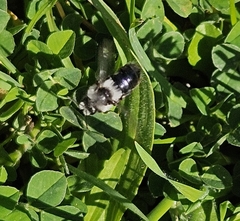

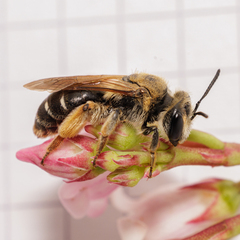


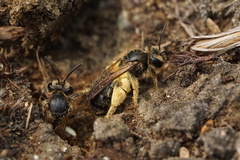


Sources
- Wikipedia: https://en.wikipedia.org/wiki/Andrena_scotica
Look it up elsewhere: GBIF · iNaturalist · BugGuide · Wikipedia
Text written 2026-10-23 from the sources above and checked sentence by sentence against them. Data fetched 2026-10-22.