 Bug FAQ
White-fringed weevil
Naupactus leucoloma · Order: Coleoptera · Family: Curculionidae
Also called: Weevil, Whitefringed beetle
Source: Wikipedia

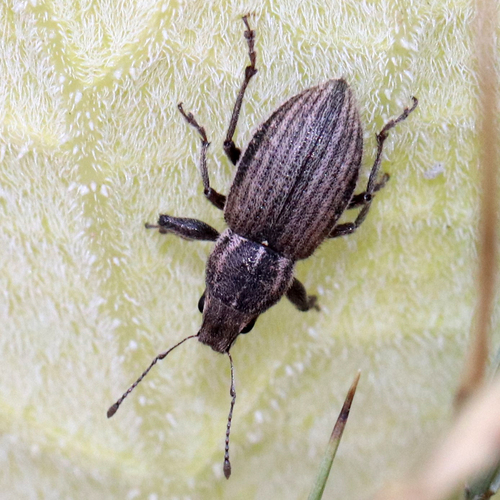
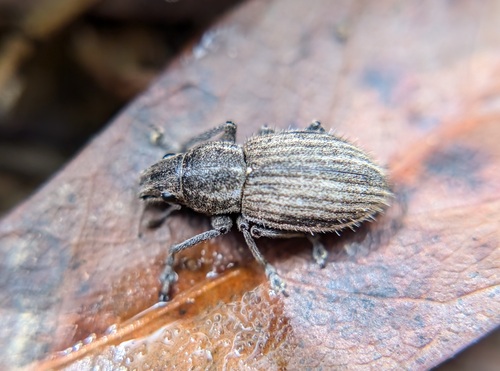
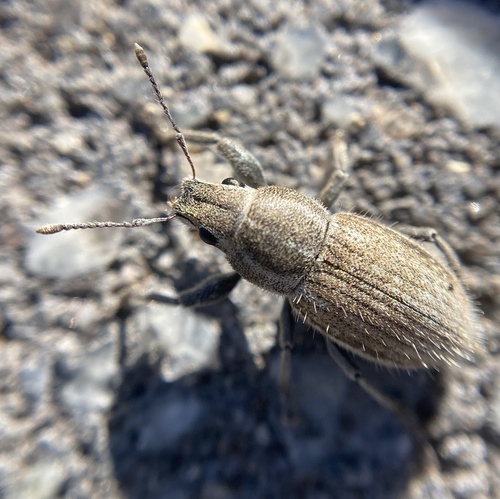
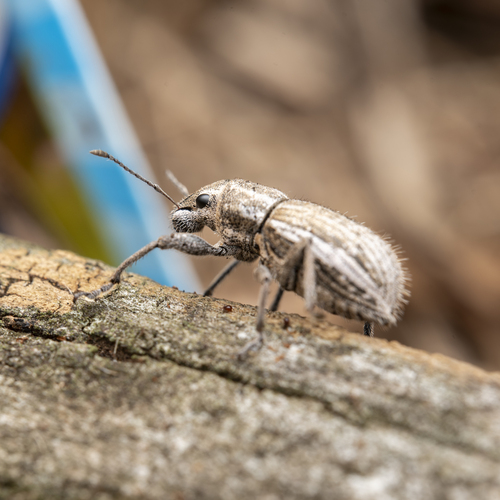
Adults are dark grey about 8 to 12 mm long, with two lighter bands on the head and thorax and a hairy back, especially on the forewings. In its native South-American range it lives on open grasslands and steppes, and it has spread to places like New Zealand where adults appear in summer months. The larvae can destroy seedlings, while adults browse a wide variety of plant leaves, causing yield loss in crops.
Source: Wikipedia
How to recognize it
It has two lighter coloured longitudinal bands on its head and thorax.
Source: Wikipedia
Size
Adults measure between 8 and 12 mm in length and about 4 mm wide at the abdomen.
Source: Wikipedia
How to get rid of it
In its native range, birds such as Milvago chimango and Belonpterus chilensis have been recorded eating the weevil and may help keep it in check. In New Zealand, house sparrows have also been observed feeding on them.
Source: Wikipedia
Where it lives
In its original range it inhabits fertile plains with temperate climates, mainly grass prairies and steppes with few trees.
Source: Wikipedia
What it eats
Adult weevils feed on the foliage of many different plant species.
Source: Wikipedia
Life cycle
Outside its native area all individuals are female and reproduce without mating (parthenogenesis). The larval stage lasts about 10 to 17 months and passes through four or five growth stages before pupating.
Source: Wikipedia
When you see it
In New Zealand adults are first seen in December and stay active through April. Emergence from the soil occurs from May to October and depends on how moist the ground is.
Source: Wikipedia
Where it comes from
It is native to much of Argentina, from Jujuy and Salta in the north down to Chubut in the south. It also occurs naturally in Uruguay and southern Brazil.
Source: Wikipedia
Where it is found in the US
Recorded in 31 of 51 states and DC. Most records: Virginia, Tennessee, North Carolina, Maryland, Texas, Missouri, Kentucky, Oklahoma.
Darker = more records. Counts are museum and citizen-science records, not population size.
Source: GBIF
Status: introduced in United States. Source: iNaturalist
Months it is reported in the US
Source: GBIF
More photos
Questions people ask
What plants can the white-fringed weevil damage?
The larvae can kill young seedlings, and adults browse a wide range of plant leaves, leading to reduced yields in crops.
Source: Wikipedia
How does this weevil reproduce in areas outside its home range?
All individuals are female there and reproduce asexually through parthenogenesis.
Source: Wikipedia
Are there any natural predators that help control them?
Certain South-American birds and house sparrows have been seen eating the weevil and may act as control agents.
Source: Wikipedia
Same family (Curculionidae)
 Green Immigrant Leaf WeevilPolydrusus formosusDamages trees, gardens or crops
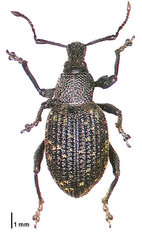 Black Vine WeevilOtiorhynchus sulcatusDamages trees, gardens or crops
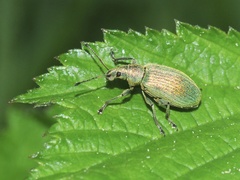 Nettle weevilPhyllobius pomaceusDamages trees, gardens or crops
 Asian Oak WeevilCyrtepistomus castaneusDamages trees, gardens or crops
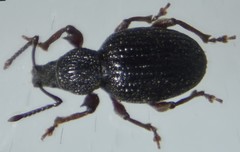 Strawberry Root WeevilOtiorhynchus ovatusDamages trees, gardens or crops
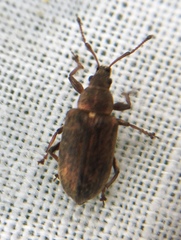 Common Leaf WeevilPhyllobius pyriDamages trees, gardens or crops
Sources
- Wikipedia: https://en.wikipedia.org/wiki/Naupactus_leucoloma
Look it up elsewhere: GBIF · iNaturalist · BugGuide · Wikipedia
Text written 2026-10-22 from the sources above and checked sentence by sentence against them. Data fetched 2026-10-22.