 Bug FAQ
Wharf Louse
Ligia exotica · Order: Isopoda · Family: Ligiidae
Also called: Wharf Isopod, Wharf roach

The wharf louse can reach about 4 cm, with males larger than females, and is dark grey with pale brown limbs. It lives on wet rocks, cliffs, jetties and harbour walls, usually just above the high-water mark. It feeds on micro-algae, diatoms, plant debris and other detritus, and reproduces by laying batches of around eighty eggs in moist cracks.
Source: Wikipedia
How to recognize it
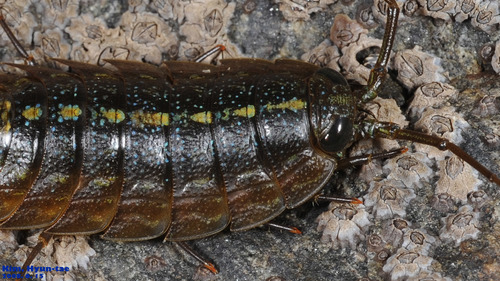
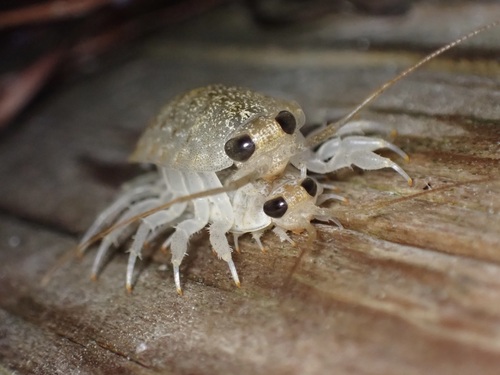
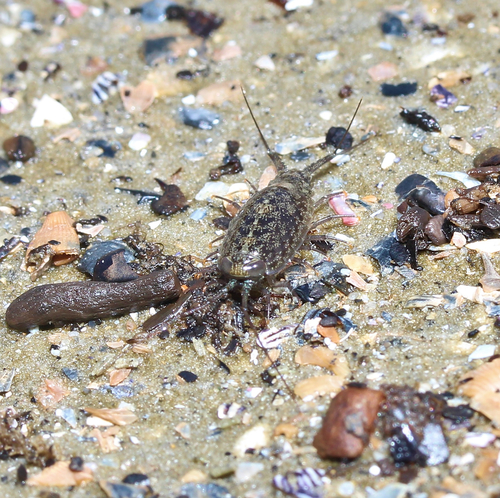
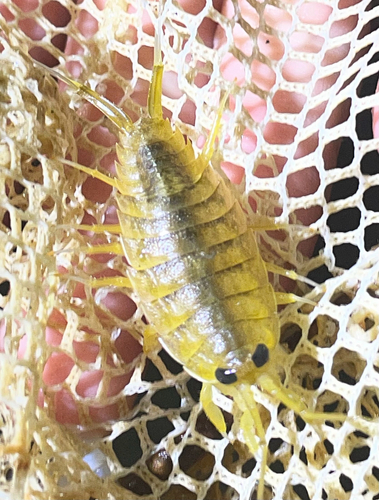
Its body is dark grey, sometimes with brown speckles, and its legs are pale brown. It has long antennae that extend beyond the body length and two bulging, unstalked eyes on the head.
Source: Wikipedia
Size
Adults can grow up to about 4 cm (1.6 in) long, with males generally larger than females.
Source: Wikipedia
What it eats
It grazes on microalgae and diatoms and scavenges plant remains and other detritus.
Source: Wikipedia
Life cycle
Individuals are either male or female. Fertilisation occurs internally and females lay about eighty eggs at a time in moist cracks and fissures.
Source: Wikipedia
Where it comes from
It is thought to be native to western European and Mediterranean coasts. Some authorities suggest an origin in the Pacific and Indian Oceans.
Source: Wikipedia
Where it is found in the US
Recorded in 16 of 51 states and DC. Most records: Florida, Maryland, Virginia, Texas, South Carolina, Georgia, North Carolina, Alabama.
Darker = more records. Counts are museum and citizen-science records, not population size.
Source: GBIF
Status: introduced in North America; introduced in United States. Source: iNaturalist
Months it is reported in the US
Source: GBIF
More photos
Questions people ask
Are wharf lice a pest in homes?
They are marine insects that live on rocks, jetties and harbour walls, not inside houses.
Source: Wikipedia
Same family (Ligiidae)


Sources
- Wikipedia: https://en.wikipedia.org/wiki/Ligia_exotica
Look it up elsewhere: GBIF · iNaturalist · BugGuide · ITIS · Wikipedia
Text written 2026-10-22 from the sources above and checked sentence by sentence against them. Data fetched 2026-10-22.