 Bug FAQ
Sea-slater
Ligia dilatata · Order: Isopoda · Family: Ligiidae
Also called: Benguella Seaslater
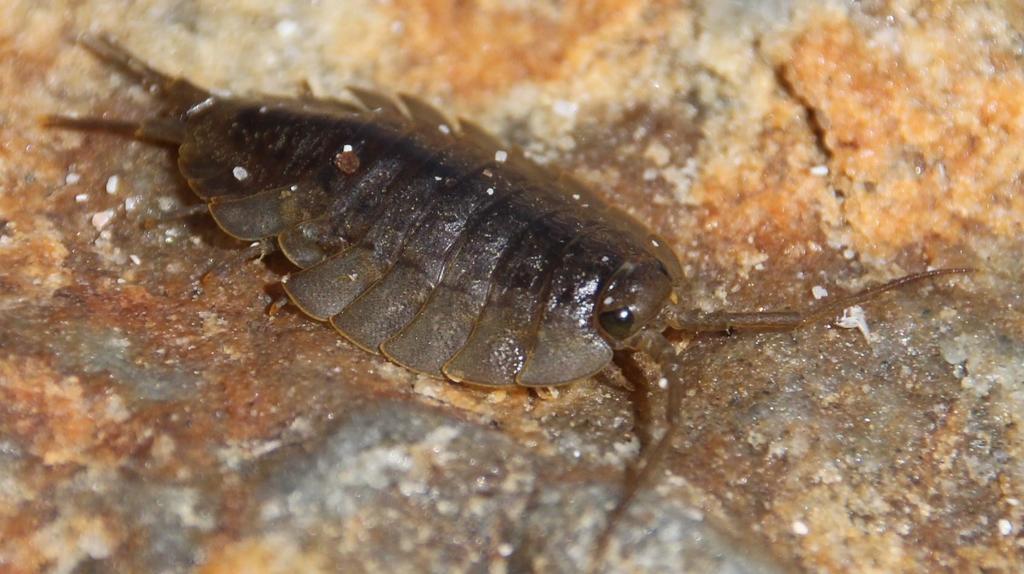
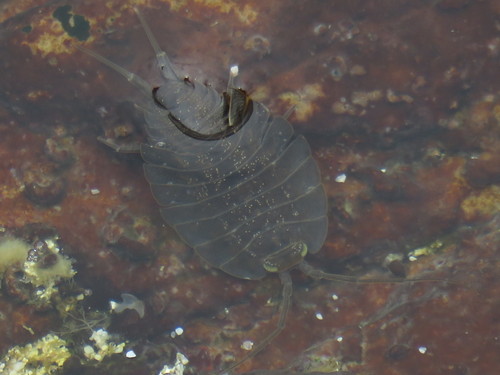
Sea-slater has a finely granular surface, a slightly convex body and large, bulging eyes. It lives about two years and grows faster in winter when kelp washes ashore. Females begin reproducing after about a year and the brood lasts five to six weeks.
Source: Wikipedia
How to recognize it
Its shell is finely granular, the body is slightly convex, the eyes are large and convex, and the uropods are relatively small.
Source: Wikipedia
What it eats
Its diet consists mainly of dislodged kelp species that end up on the beach.
Source: Wikipedia
Life cycle
The species lives about two years; females start reproducing at twelve months and usually do not breed twice.
Source: Wikipedia
When you see it
Growth is slower in summer and speeds up in winter when food is more abundant.
Source: Wikipedia
Where it comes from
It shares part of its range with L. glabrata but can be distinguished from it.
Source: Wikipedia
Lookalikes
It can be told apart from L. glabrata by its longer antennae that reach the end of the thorax.
Source: Wikipedia
More photos
Questions people ask
How can I tell a sea-slater apart from similar species?
Look at the antennae to they are longer and extend to the end of the thorax, unlike those of L. glabrata.
Source: Wikipedia
How long does a sea-slater live?
It typically lives about two years, with females starting to reproduce after roughly one year.
Source: Wikipedia
Same family (Ligiidae)


Sources
- Wikipedia: https://en.wikipedia.org/wiki/Ligia_dilatata
Look it up elsewhere: GBIF · iNaturalist · BugGuide · ITIS · Wikipedia
Text written 2026-10-23 from the sources above and checked sentence by sentence against them. Data fetched 2026-10-23.