 Bug FAQ
Common Sea Slater
Ligia oceanica · Order: Isopoda · Family: Ligiidae
Also called: great sea-slater, sea slater

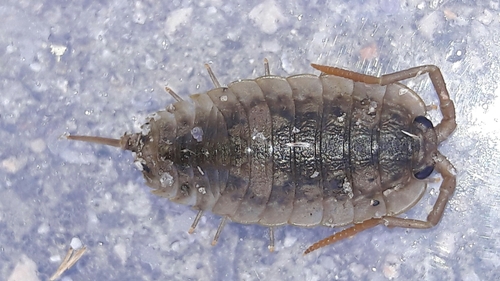
The common sea slater is an oval, flat isopod up to 35 mm long, coloured brown, slate-grey or olive-green. It lives on rocky littoral zones such as boulder beaches, rock cliffs and seawalls, tolerating near-freezing temperatures. It feeds on algae, diatoms and decaying seaweed and is prey for shorebirds, rats and raccoons.
Source: Wikipedia
How to recognize it
The body is flat, oval-shaped, widest in the middle and about twice as long as it is broad.
Source: Wikipedia
Size
Adults measure between 20 mm and 35 mm in length.
Source: Wikipedia
Where it lives
Found on rocky substrates of the littoral zone such as boulder beaches, rock cliffs, harbour walls and jetties. Uses rock crevices for temperature and moisture control and can survive near-freezing winter temperatures.
Source: Wikipedia
What it eats
Serves as prey for shorebirds, rats and raccoons.
Source: Wikipedia
Life cycle
Breeds in spring and summer. Individuals live 2.5 to 3 years and usually breed only once.
Source: Wikipedia
When you see it
Breeding occurs during spring and summer. Nocturnal and hides in crevices by day, emerging at night to feed.
Source: Wikipedia
Where it comes from
Native from southern Norway down to Morocco, including the western Baltic Sea to Bornholm and Rostock. Also recorded on the Faroe Islands and southern Iceland.
Source: Wikipedia
Lookalikes
Molecular studies suggest Ligia is more closely related to marine isopods of Valvifera and Sphaeromatidea than to terrestrial woodlice. Phylogenetic analyses cast doubt on its placement in Oniscidea, aligning it with marine groups.
Source: Wikipedia
Where it is found in the US
Recorded in 6 of 51 states and DC. Most records: Maine, Rhode Island, Massachusetts, New Hampshire, North Carolina, Washington.
Darker = more records. Counts are museum and citizen-science records, not population size.
Source: GBIF
Status: introduced in North America; introduced in United States; introduced in Canada. Source: iNaturalist
Months it is reported in the US
Source: GBIF
More photos

Questions people ask
How big does the common sea slater get?
Adults range from 20 mm up to 35 mm in length.
Source: Wikipedia
Where does this isopod live?
It inhabits rocky littoral zones such as boulder beaches, rock cliffs, harbour walls and jetties.
Source: Wikipedia
Same family (Ligiidae)


Sources
- Wikipedia: https://en.wikipedia.org/wiki/Ligia_oceanica
Look it up elsewhere: GBIF · iNaturalist · BugGuide · ITIS · Wikipedia
Text written 2026-10-23 from the sources above and checked sentence by sentence against them. Data fetched 2026-10-22.