 Bug FAQ
Western Thistle Longhorn Bee
Melissodes rivalis · Order: Hymenoptera · Family: Apidae
Also called: Rival Long-horned Bee, Rival Longhorn Bee, Western Thistle Long-horned Bee
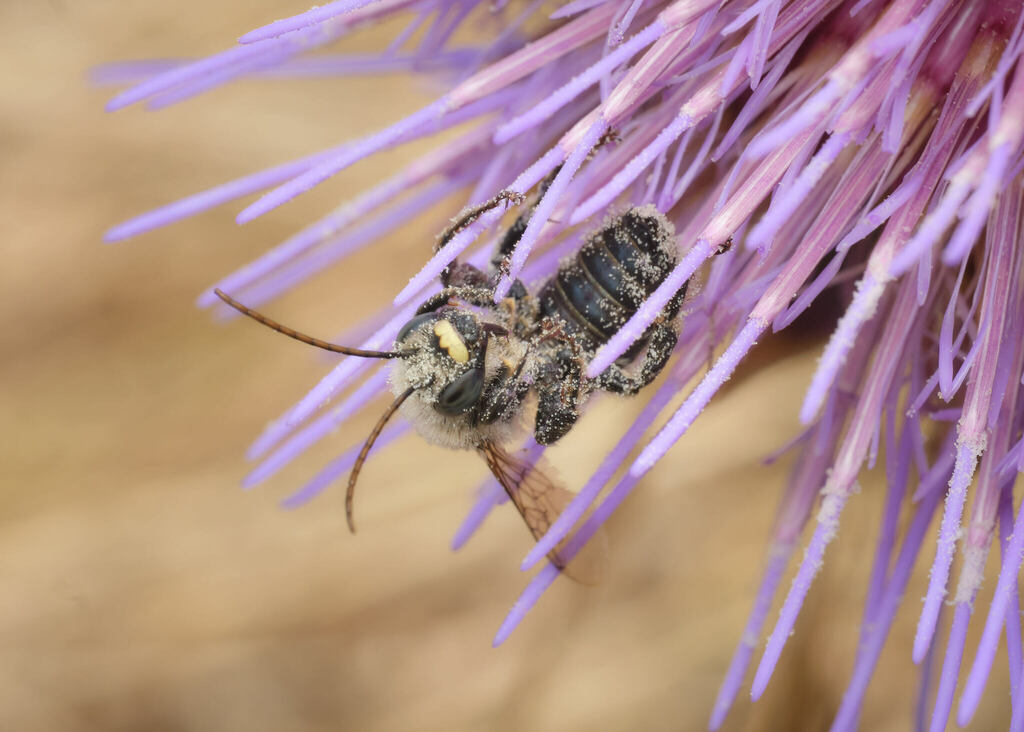
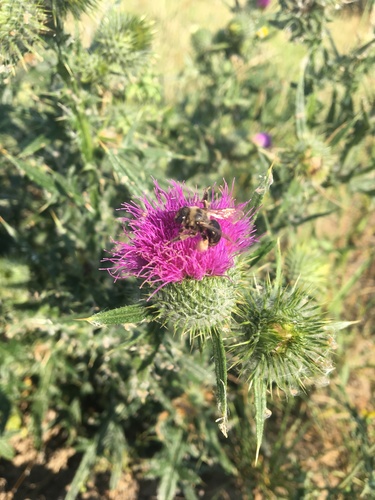
The Western Thistle Longhorn Bee has an elongated body, a dark gray abdomen with white or cream hairs, and clear wings with faintly cloudier beige tips. It lives in the northern United States and southern Canada, nesting in the ground under bushes and pollinating thistles (Cirsium species).
Source: Wikipedia
How to recognize it
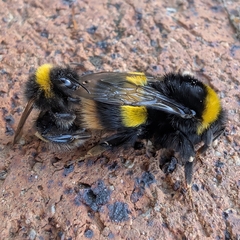
The bee is smaller than a honey bee, with a long body, dark gray abdomen striped with white or cream hairs. Its wings are clear and have a faintly cloudier beige edge at the tip.
Source: Wikipedia
Where it lives
Females dig solitary ground nests, usually under a bush or brush, and create a single chamber for an egg and pollen ball. The species is commonly seen visiting thistle flowers (Cirsium) for pollination.
Source: Wikipedia
What it eats
Adults feed on pollen from thistles (Cirsium species) while pollinating them.
Source: Wikipedia
Life cycle
The bee is solitary; each female builds and guards her own nest without help from a hive. A nest typically contains one egg and a pollen ball; nests may be isolated or found in small groups.
Source: Wikipedia
Where it comes from
It is native to Montana and also occurs in Idaho, Wyoming, and Minnesota. In Canada it is recorded in British Columbia, Alberta, Saskatchewan, and Manitoba.
Source: Wikipedia
Lookalikes
It can be confused with other Melissodes species such as Melissodes agilis that live in the same region.
Source: Wikipedia
Where it is found in the US
Recorded in 14 of 51 states and DC. Most records: Colorado, Washington, Utah, Wyoming, Oregon, Arizona, Idaho, North Dakota.
Darker = more records. Counts are museum and citizen-science records, not population size.
Source: GBIF
Status: native in North America; native in Canada; native in United States. Source: iNaturalist
Months it is reported in the US
Source: GBIF
More photos
Questions people ask
What plants does the Western Thistle Longhorn Bee visit?
It commonly visits thistles (Cirsium species) for pollen.
Source: Wikipedia
Where is this bee found?
It is native to Montana and also occurs in Idaho, Wyoming, Minnesota, and the Canadian provinces of British Columbia, Alberta, Saskatchewan, and Manitoba.
Source: Wikipedia
How does the female Western Thistle Longhorn Bee nest?
The female digs a hole in the ground under a bush or brush and creates a single chamber for an egg and pollen ball.
Source: Wikipedia
Same family (Apidae)


Sources
- Wikipedia: https://en.wikipedia.org/wiki/Melissodes_rivalis
Look it up elsewhere: GBIF · iNaturalist · BugGuide · ITIS · Wikipedia
Text written 2026-10-24 from the sources above and checked sentence by sentence against them. Data fetched 2026-10-24.