 Bug FAQ
Wandering Violin Mantis
Gongylus gongylodes · Order: Mantodea · Family: Empusidae
Also called: Indian Rose Mantis, Violin Mantis, ornate mantis

The wandering violin mantis can grow up to about 11 cm, with females around 10 cm and males about 9 cm. It lives in southern India, Sri Lanka, and parts of Southeast Asia, feeds on flying insects, and lives communally without much cannibalism.
Source: Wikipedia
How to recognize it
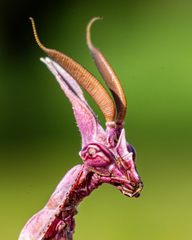
It has very thin legs with large, leaf-like appendages and sways its body like a stick in the wind.
Source: Wikipedia
Size
Females are about 10 cm (3 in) and males about 9 cm.
Source: Wikipedia
Does it bite or sting?
It is not particularly aggressive and is often kept as a pet.
Source: Wikipedia
Where it lives
It primarily hunts flying insects. The species lives and breeds in large groups, showing little cannibalism.
Source: Wikipedia
What it eats
It mainly eats flying insects.
Source: Wikipedia
Where it comes from
Its native range includes southern India and Sri Lanka.
Source: Wikipedia
More photos


Questions people ask
How big does the wandering violin mantis get?
Females reach about 10 cm and males about 9 cm, with a maximum length of roughly 11 cm.
Source: Wikipedia
What does it look like?
It has extremely slender limbs with large leaf-like appendages and sways its body like a stick in the wind.
Source: Wikipedia
Is the wandering violin mantis aggressive?
It is not particularly aggressive and is often kept as a pet.
Source: Wikipedia
Same family (Empusidae)


Sources
- Wikipedia: https://en.wikipedia.org/wiki/Gongylus_gongylodes
Look it up elsewhere: GBIF · iNaturalist · BugGuide · Wikipedia
Text written 2026-10-23 from the sources above and checked sentence by sentence against them. Data fetched 2026-10-23.